
Urethral bulking for stress urinary incontinence: a first procedure or an option after a sling?
Leaking urine when you cough, laugh, exercise or lift something is called stress urinary incontinence (SUI). It differs from urgency incontinence, when a sudden need to pass urine leads to leakage. Some women have both. Identifying which symptom is most troublesome matters because an injection aimed at SUI will not reliably treat urgency.
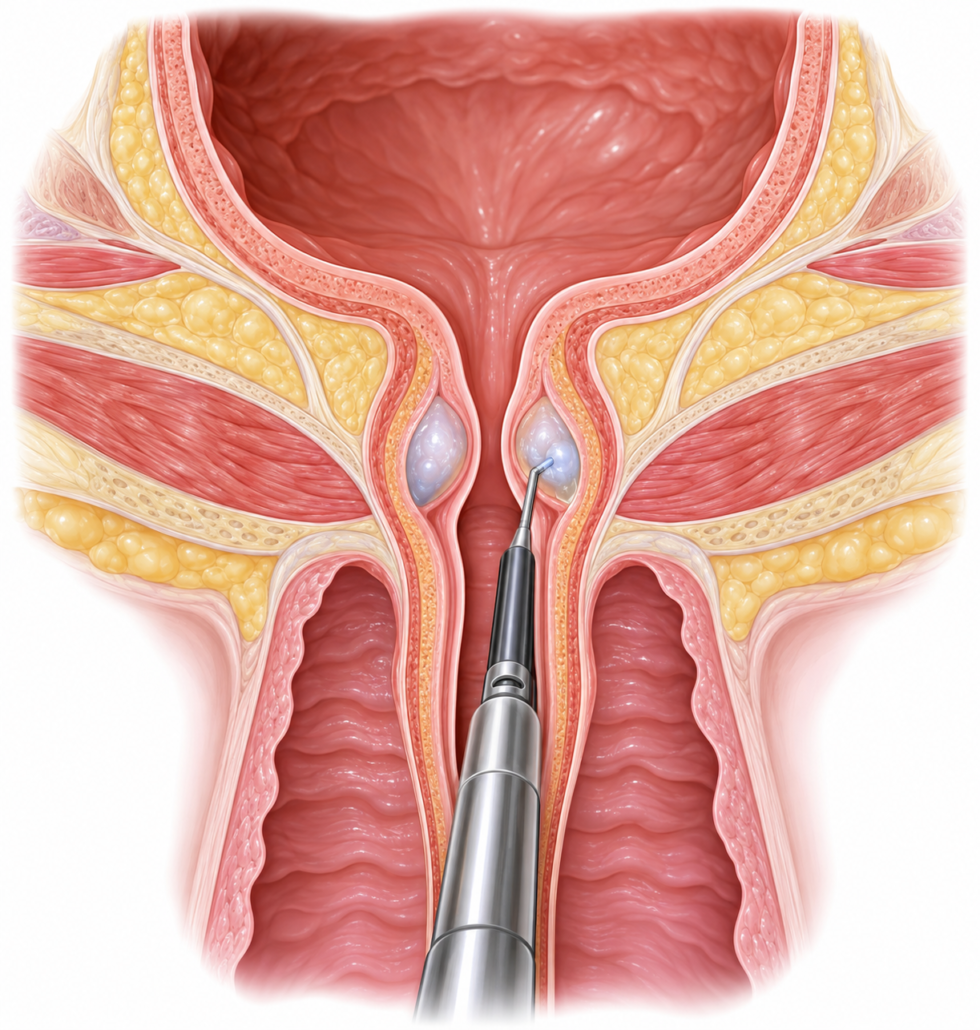
Urethral bulking involves placing small deposits of material into the wall of the urethra, usually through a fine instrument passed into the urethra. The deposits help the urethra close when pressure rises. You may hear this described as periurethral bulking, although many contemporary injections are delivered through the urethra into its surrounding wall. This is generally a day procedure under local anaesthesia or sedation/general anaesthesia, depending on the circumstances. It does not place a sling or mesh tape.
Could bulking be my first procedure?
Yes. After a trial of pelvic floor muscle training and discussion of other conservative measures, bulking can be chosen as a first procedure for appropriately assessed SUI. It may appeal to someone seeking a shorter procedure and recovery, or wishing to avoid a sling. It is also an option when a larger operation or anaesthetic carries additional risk. It is not usually the first treatment before conservative care. USANZ’s 2026 position statement lists bulking alongside autologous fascial slings, colposuspension and synthetic midurethral slings among the standard options that should be discussed. UGSA’s patient information stresses its lower success and frequent need for repeat treatment. [1–3]
Bulking, synthetic midurethral sling surgery, a sling made from the patient’s own fascia, and colposuspension have different benefits and risks. A donated-tissue (allograft) sling is distinct from a sling made from your own tissue (autograft) and from a synthetic mesh sling; the strength and duration of evidence for each are different. No single procedure is best for every woman. [1,4]
How effective and durable is it?
The realistic aim is often less leakage, rather than guaranteed dryness. Success figures change substantially depending on whether researchers count complete dryness, improvement, satisfaction, or avoidance of further treatment. UGSA’s patient leaflet quotes about 40–50% cure or improvement and reports that approximately 30% need a further injection within two years. These are broad counselling figures, not a prediction for an individual. [2]
Some women remain improved for years, but repeat injections or another operation may be needed. In a randomised comparison of polyacrylamide hydrogel injection and synthetic tension-free vaginal tape for primary SUI, the tape achieved better objective continence at one year (negative cough test 95.0% versus 66.4%). The five-year follow-up did not establish that injection was non-inferior to tape. The EAU similarly advises that bulking is generally less effective than slings or colposuspension for cure, and that repeat injection is likely. These findings do not mean everyone should have a tape: the value of a less invasive procedure and the acceptability of a possible repeat treatment are personal considerations. [4–6]
What if I still leak after a sling?
Bulking can be considered for persistent leakage soon after a sling or recurrent leakage after an initial period of improvement. It can sometimes reduce leakage without placing another sling. A 2022 systematic review of 11 studies after synthetic midurethral sling failure reported a pooled 75% cure-or-improvement rate, but also pooled failure and further-operation rates of 32% and 25%. The studies differed considerably in their patients, products, follow-up and definitions of success; the 75% figure should not be presented as a personal chance of cure. An American Urogynecologic Society clinical practice statement also recognises bulking as an option after a sling. [7,8]
After an allograft sling, the same clinical possibility exists, but the published post-sling bulking evidence is mainly about synthetic midurethral slings. We should not simply transfer those success figures to donated-tissue slings. The precise graft, previous surgery and examination findings should guide an individual discussion.
An injection should not be used to mask a sling complication. Before offering more treatment, I would review the original operation, check urine and bladder emptying, examine for prolapse, scarring and vaginal exposure, and assess whether leakage occurs with coughing or with urgency. Cystoscopy, a bladder diary, pad testing or urodynamics may be appropriate, especially after previous surgery, mixed symptoms, pain, blood in the urine or difficulty emptying. A tape or graft causing obstruction, exposure, erosion, infection or pain may require its own assessment and treatment. [1,3,7]
Is it safe? What are the side effects?
Most reported problems are short lived, but no injection is risk free. Possible effects include:
- burning when passing urine and a little blood in the urine;
- urinary tract infection;
- temporary difficulty emptying the bladder, occasionally requiring short-term catheterisation;
- new or persisting urgency symptoms; and
- incomplete benefit, recurrence or the need for another injection or operation.
Less commonly, there may be persistent pain, a collection or infection at the injection site, or a reaction or complication related to the particular material. Risks also depend on anaesthesia, previous surgery and the chosen product. Emptying should be checked before discharge. Seek prompt assessment if you cannot pass urine, develop fever, worsening pain or heavy bleeding. [2,4,8]
Choosing a treatment
The first step is to confirm the type and severity of leakage and clarify your goals: complete dryness, meaningful improvement, shorter recovery, avoiding mesh, or avoiding the likelihood of repeat treatment. Pelvic floor therapy remains an initial option. When a procedure is appropriate, we can compare bulking with sling and colposuspension procedures using your examination findings, health history and preferences. If you have already had a sling, the reason for the continuing leakage deserves a fresh assessment before choosing another procedure.
This page is general education, not a recommendation for a particular product or a promise of a result. Treatment, including its material, risks, costs and alternatives, should be discussed during an individual consultation.
References
- Urological Society of Australia and New Zealand (USANZ). Surgical Treatment of Stress Urinary Incontinence: Position Statement Pol 054, version 2.0. Approved 9 May 2026.
- Urogynaecological Society of Australasia (UGSA). Urethral Bulking: Patient Information.
- UGSA. Stress Urinary Incontinence: Patient Resources.
- European Association of Urology. Guidelines on Non-neurogenic Female Lower Urinary Tract Symptoms: Disease Management, section 4.2.4.c.2.c.
- Itkonen Freitas A-M, et al. Tension-free vaginal tape surgery versus polyacrylamide hydrogel injection for primary stress urinary incontinence: a randomised clinical trial. Journal of Urology. 2020.
- Itkonen Freitas A-M, et al. Tension-free vaginal tape versus polyacrylamide hydrogel injection for stress urinary incontinence: five-year follow-up. NEJM Evidence. 2025.
- Braga A, et al. Urethral bulking agents for the treatment of recurrent stress urinary incontinence: a systematic review and meta-analysis. Maturitas. 2022. doi:10.1016/j.maturitas.2022.05.007.
- American Urogynecologic Society. Urethral Bulking: Clinical Practice Statement. Urogynecology. 2024. doi:10.1097/SPV.0000000000001548.




Leave a Reply
Want to join the discussion?Feel free to contribute!