Testicular rupture: causes, warning signs, diagnosis and treatment
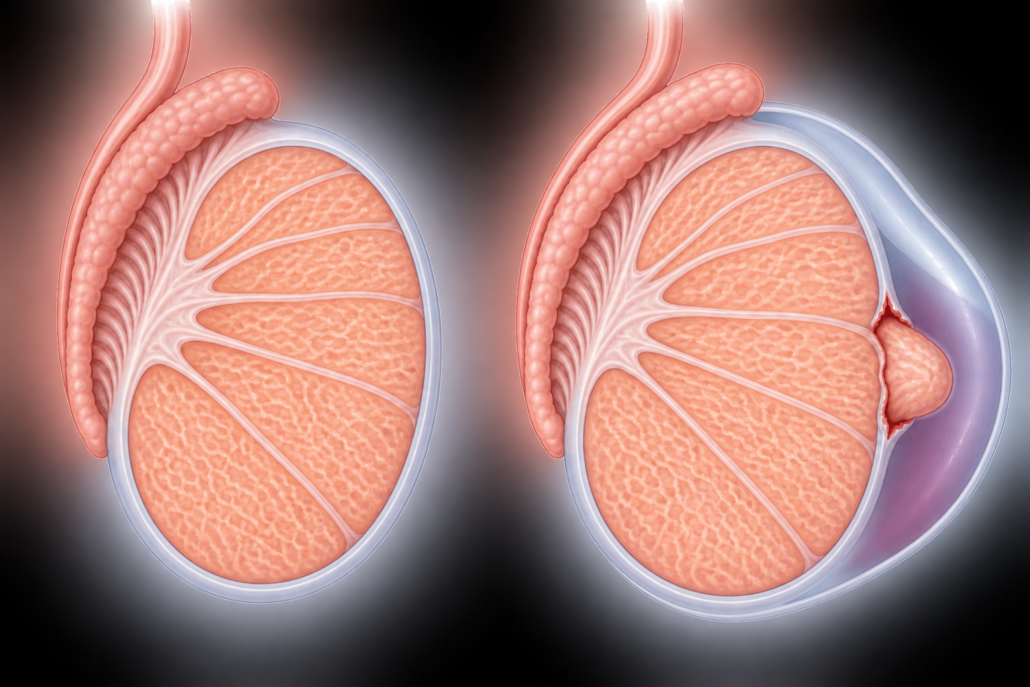
Testicular rupture is a surgical emergency. It occurs when trauma tears the tough outer covering of the testis (the tunica albuginea), allowing testicular tissue to protrude through the defect. Prompt assessment offers the best opportunity to control bleeding, relieve pain and preserve viable testicular tissue.
Seek urgent medical care: After an injury, go promptly to the nearest emergency department if there is severe or increasing scrotal pain, marked swelling or bruising, nausea or vomiting, a testis that feels abnormal or cannot be clearly felt, an open wound, or blood at the urinary opening or in the urine. Do not delay assessment while waiting to see whether the swelling settles.
What causes a testicular rupture?
Most ruptures follow a forceful, direct blow that compresses the testis against the pubic bone. Causes include:
- contact sport, particularly without an appropriate protective cup;
- bicycle or motorcycle accidents and straddle injuries;
- falls, motor-vehicle trauma, workplace injuries or assault;
- a kick, ball or other high-impact object striking the scrotum; and
- penetrating trauma, such as a stab, gunshot, machinery injury or animal bite.
A major blunt injury can also cause a scrotal haematoma, haematocele (blood around the testis), testicular contusion, torsion, fracture without tunical rupture, or injury to the epididymis or spermatic cord. These conditions can look similar, and more than one injury may be present.
How does it present?
Typical features include immediate severe pain followed by rapidly developing swelling, tenderness and bruising. Nausea, vomiting or faintness may occur. The normal outline of the testis may be difficult to feel because of pain and swelling. An open injury, scrotal skin loss or bleeding may be present after penetrating or high-energy trauma.
Symptoms alone cannot reliably distinguish rupture from torsion or other serious injury. Testicular torsion may occur with or without trauma and is also time-critical. A seemingly modest external bruise does not exclude a significant internal injury.
Assessment and investigation
Assessment begins with the circumstances and timing of the injury, examination of both testes and the scrotum, and checking for injury to the penis, urethra, pelvis and abdomen where relevant. Blood at the urethral opening, difficulty passing urine or visible blood in the urine requires assessment for associated urinary-tract injury.
Ultrasound with Doppler
High-resolution scrotal ultrasound with colour Doppler is the preferred first-line imaging test for blunt testicular trauma. Findings that may indicate rupture include:
- loss of the smooth testicular contour;
- disruption of the tunica albuginea;
- heterogeneous testicular tissue;
- protrusion of tissue through a tunical defect;
- reduced or absent blood flow; and
- a surrounding haematocele.
Ultrasound is very useful but is not infallible. Pain, extensive swelling, haematoma and operator or equipment factors can make interpretation difficult. The 2026 European Association of Urology (EAU) guideline strongly recommends ultrasound for testicular trauma and surgical exploration for confirmed rupture and for inconclusive ultrasound when rupture remains a concern. Imaging should not cause an avoidable delay when the clinical findings clearly warrant surgery.
CT is useful for associated abdominal or pelvic trauma but is not the usual test for deciding whether the testis has ruptured. MRI is occasionally considered when ultrasound is equivocal and immediate exploration is not otherwise indicated, but it should not delay necessary surgery.
Treatment
Immediate care
In hospital, initial treatment may include appropriate pain relief, fasting in preparation for possible anaesthesia, scrotal support and management of other injuries. Open or contaminated wounds require wound care; tetanus status and antimicrobial treatment are considered according to the mechanism, contamination and local protocols.
Surgical exploration and repair
Confirmed or strongly suspected rupture is generally treated by urgent scrotal exploration. During surgery, the surgeon will usually:
- evacuate blood clot and inspect the testis and surrounding structures;
- control bleeding;
- remove only tissue that is clearly non-viable;
- preserve as much healthy, perfused testicular tissue as possible; and
- close the tunica albuginea, sometimes using local tissue coverage when primary closure would place the remaining testis under excessive tension.
Associated injuries to the epididymis or spermatic cord are addressed where possible. A drain may occasionally be used. After surgery, patients commonly require scrotal support, analgesia, wound care and temporary restriction of sport, heavy lifting and sexual activity. The exact plan depends on the injury and operation.
Older clinical series reported testicular salvage rates around 80–90% when rupture was recognised and repaired promptly. These figures describe groups of patients and cannot predict an individual result. The chance of salvage depends on the energy and type of trauma, the amount of tissue destruction, blood supply, contamination, associated injuries and time to treatment.
Is non-operative treatment ever suitable?
Minor trauma with an intact tunica, preserved blood flow and a small, stable haematoma may sometimes be managed with observation, analgesia, ice used safely, scrotal support and arranged review. This is not the usual management for a confirmed rupture. Increasing pain, swelling, fever or other deterioration requires urgent reassessment.
When is orchidectomy necessary?
Orchidectomy means removal of a testis. It is not the preferred treatment when viable tissue can be repaired. It may nevertheless be necessary when the testis is completely shattered, devascularised or infarcted; the spermatic cord is irreparably damaged or avulsed; bleeding cannot otherwise be controlled; contamination and tissue destruction are extreme; or no meaningful viable tissue remains.
The decision is usually made during exploration after blood supply and tissue viability have been assessed. Surgeons aim to conserve viable testicular tissue, but retaining a completely non-viable testis can expose the patient to infection, persistent pain and further surgery. Severe penetrating injuries and delayed treatment are more likely to require orchidectomy than a limited rupture treated early.
If removal is required, a testicular prosthesis can be discussed. It is cosmetic and does not make sperm or testosterone. Placement may be performed at the same operation or later, depending on contamination, swelling, patient preference and clinical circumstances.
Effects on fertility and testosterone
The effect on fertility varies considerably.
- Unilateral injury: A healthy opposite testis will often produce enough testosterone and sperm for normal sexual development, erections and natural conception. However, normal fertility cannot be guaranteed. Trauma itself, loss of testicular volume, later atrophy and unilateral orchidectomy can reduce sperm reserve.
- Testicular repair: Preserving viable tissue is generally preferred and may better preserve sperm-producing and hormonal function. Small human follow-up studies suggest that semen abnormalities can occur after trauma even when testosterone remains normal; the evidence is limited by small patient numbers.
- Bilateral injury or a solitary testis: The risk to fertility and testosterone production is much greater. Loss of both testes causes permanent infertility and requires long-term testosterone replacement. Preservation of even a portion of viable tissue may therefore be especially important.
For severe bilateral injury, injury to a solitary testis, pre-existing subfertility, or concern about future family planning, early discussion with a urologist and fertility specialist is appropriate. Semen analysis, reproductive hormone testing and sperm cryopreservation may be considered when feasible; emergency surgery should not be dangerously delayed to obtain a sample. Follow-up may include examination, ultrasound when indicated, testosterone, LH and FSH testing, and semen analysis after recovery if fertility is a concern.
Possible complications
Even after appropriate treatment, complications can include:
- infection, wound problems or recurrent haematoma;
- testicular atrophy or loss of blood supply;
- persistent scrotal discomfort or chronic pain;
- impaired sperm production or subfertility;
- reduced testosterone production, particularly after bilateral injury;
- the need for later surgery or orchidectomy; and
- psychological distress or concern about body image and fertility.
Increasing pain or swelling, fever, wound discharge, skin discolouration, difficulty passing urine or feeling generally unwell after discharge warrants urgent medical review.
The practical message
Following significant scrotal trauma, early assessment matters. Ultrasound with Doppler is the main imaging investigation, but a reassuring-looking exterior, or an uncertain scan, does not safely exclude rupture. Timely exploration and repair provide the best opportunity to save viable testicular tissue. Orchidectomy is reserved for a testis that cannot be safely or meaningfully salvaged.
Important information
This article provides general health information and does not replace an examination, diagnosis, individual medical advice or informed consent. Treatment and outcomes vary according to the mechanism, severity, timing, associated injuries, health history and operative findings. If testicular rupture or torsion is suspected, seek urgent assessment at an emergency department.
References
- European Association of Urology. EAU Guidelines on Urological Trauma: Urogenital Trauma Guidelines (2026). Uroweb guideline.
- Morey AF, Brandes S, Dugi DD III, et al. Urotrauma: AUA Guideline. Journal of Urology. 2014;192:327–335. Full text via PubMed Central. Updated guideline information: American Urological Association.
- Morey AF, Broghammer JA, Hollowell CMP, McKibben MJ, Souter L. Urotrauma Guideline 2020: AUA Guideline. Journal of Urology. 2021;205(1):30–35. PubMed.
- Buckley JC, McAninch JW. Use of ultrasonography for the diagnosis of testicular injuries in blunt scrotal trauma. Journal of Urology. 2006;175(1):175–178. PubMed.
- Cass AS, Luxenberg M. Testicular injuries. Urology. 1991;37(6):528–530. PubMed.
- Lin WW, Kim ED, Quesada ET, Lipshultz LI, Coburn M. Unilateral testicular injury from external trauma: evaluation of semen quality and endocrine parameters. Journal of Urology. 1998;159(3):841–843. PubMed.
- Kukadia AN, Ercole CJ, Gleich P, Hensleigh H, Pryor JL. Testicular trauma: potential impact on reproductive function. Journal of Urology. 1996;156(5):1643–1646. PubMed.
- Yagil Y, Naroditsky I, Milhem J, et al. Role of Doppler ultrasonography in the triage of acute scrotum in the emergency department. Journal of Ultrasound in Medicine. 2010;29(1):11–21. PubMed.
- Australian Health Practitioner Regulation Agency. Guidelines for advertising a regulated health service and acceptable evidence in health advertising. Ahpra Advertising Hub.
- Therapeutic Goods Administration. Advertising health services that involve therapeutic goods (updated 18 June 2026). TGA guidance.




Leave a Reply
Want to join the discussion?Feel free to contribute!