
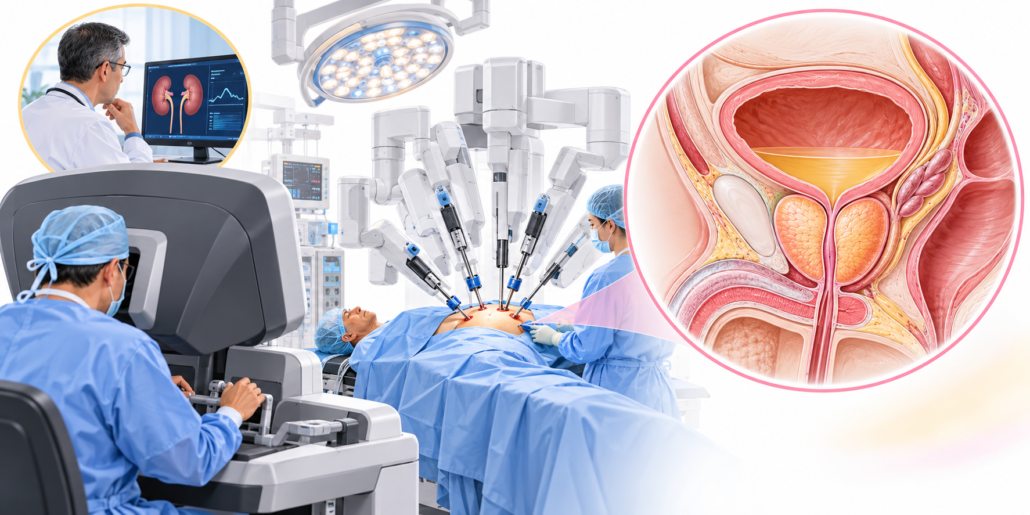
Prostate cancer with kidney failure: is surgery, focal therapy or radiation the right choice?
A patient guide by Dr Jo Schoeman
A diagnosis of prostate cancer is unsettling. Having chronic kidney disease or needing dialysis can make treatment decisions feel even harder. The reassuring point is that kidney failure does not automatically rule out treatment. The best choice depends on the cancer, the degree of kidney impairment, other medical conditions and, crucially, whether a kidney transplant is planned.
What does Gleason 3+4 mean?
Gleason 3+4=7 is Grade Group 2 prostate cancer. Most of the sampled tumour has pattern 3, with a smaller component of pattern 4. It is generally less concerning than Gleason 4+3=7, but “3+4” alone cannot tell us whether immediate treatment is needed.
I would review the PSA and PSA density, examination, MRI findings, number and length of positive biopsy cores, percentage of pattern 4, any cribriform or intraductal cancer, and whether disease is confined to the prostate. Kidney function, dialysis schedule, life expectancy and transplant eligibility are considered alongside these findings. Some men have favourable intermediate-risk cancer; others have features that make definitive treatment more appropriate. Staging scans are selected according to overall risk rather than biopsy grade alone. [1,2]
Could active surveillance be reasonable?
Yes, for selected men with small-volume, favourable Grade Group 2 cancer. Surveillance means scheduled PSA tests, clinical review, MRI where useful and repeat biopsy when indicated. It keeps treatment available if the cancer changes. It is a particularly meaningful option when another serious illness makes the harms of immediate treatment more likely to outweigh its benefit. It does, however, require a patient who can attend follow-up and accepts a small increased risk of progression compared with immediate treatment. [1,2]
If kidney disease or other illnesses substantially limit life expectancy, watchful waiting may be more appropriate: care focuses on symptoms rather than routine testing intended to trigger curative treatment. This is a separate decision from active surveillance. [1]
Can radical prostatectomy or robotic surgery be performed?
Often, yes. Chronic kidney disease and dialysis are not automatic contraindications to radical prostatectomy. Robotic assisted surgery may offer less blood loss and a shorter hospital stay than open surgery in selected patients, but it still involves general anaesthesia, abdominal insufflation and a head-down operating position. Advanced kidney disease increases the importance of planning for bleeding, infection, fluid and electrolyte balance, medication dosing and postoperative kidney injury. Population studies find higher complication rates in patients with chronic kidney disease, particularly advanced disease; individual risk varies considerably. [3,4]
Before an operation I would coordinate with the nephrologist, anaesthetist and, where relevant, dialysis team. We would assess cardiovascular health, haemoglobin, potassium, anticoagulants, residual kidney function and the timing of dialysis. Surgery also carries the usual risks of urinary leakage or incontinence, erectile dysfunction, infertility, blood clots and possible need for further cancer treatment. Whether a robotic approach is feasible depends on the patient and the surgical team; it is not automatically a safer choice for every person with kidney failure. [1,3,4]
Is focal therapy a better option?
Not simply because the kidneys are failing. Focal therapy treats the visible cancer-bearing portion of the prostate, using a technique such as focused ultrasound, cryotherapy or another ablative method. It may appeal to men hoping to reduce urinary or sexual side effects, but the cancer can be present elsewhere in the gland, and longer-term cancer control is less certain than for established whole-gland treatments. Further MRI, biopsies and sometimes repeat treatment are necessary.
The AUA/ASTRO guideline notes a lack of high-quality comparisons with surgery, radiation and surveillance. European guidance restricts focal treatment to settings with careful prospective follow-up, such as a trial or registry. Kidney disease alone does not establish that focal treatment is preferable. In a suitable patient it can be discussed with a specialist who explains uncertainty, access, costs and a clear follow-up plan. [1,2]
Is radiotherapy an option?
Yes. External beam radiotherapy avoids major surgery and usually does not expose the kidneys directly when treating a prostate confined to the pelvis. Options include moderately shortened courses and, for selected men, more condensed schedules or brachytherapy. The radiation oncologist will tailor treatment to the cancer and urinary function. Depending on whether the disease is favourable or unfavourable intermediate risk, a course of androgen deprivation therapy (ADT) may also be advised; ADT has its own effects on energy, muscle, bone and metabolic health. [1,2]
Radiotherapy may cause temporary urinary frequency, burning or bowel upset; longer-term urinary, bowel or erectile effects are also possible. Existing urinary obstruction and kidney transplant anatomy can change planning. In a transplant recipient, the graft and ureter may sit in the pelvis, so radiation dose constraints require particular attention. Dialysis, by itself, does not make prostate radiation impossible. [1,2]
What if a kidney transplant is planned?
This is a central part of the discussion. A transplant team may need to know whether the cancer is under surveillance or has been treated, its estimated risk of progression and the proposed follow-up. The presence of prostate cancer does not automatically mean that transplantation must wait for a fixed number of years; transplant eligibility is individual and should be discussed directly with the transplant team. A transplanted kidney in the pelvis also affects the planning of later pelvic surgery or radiotherapy. [5]
How do we decide?
| Option | When it may fit | Main trade-off |
|---|---|---|
| Active surveillance | Low-volume, favourable Grade Group 2 disease | Regular testing and a possibility of later treatment |
| Robotic radical prostatectomy | Fit patient seeking definitive local treatment | Anaesthetic and surgical risks, with continence and erectile side effects |
| Radiotherapy | Patient seeking definitive treatment without prostate removal | Urinary, bowel and sexual effects; ADT may be needed |
| Focal therapy | Carefully selected patient after discussion of uncertainty | Less established long-term cancer control and ongoing biopsies |
| Watchful waiting | Limited life expectancy or major competing health risks | Treats symptoms if they arise rather than aiming for cure |
There is no universal winner between robotic surgery and radiation for Gleason 3+4 cancer with kidney failure. A multidisciplinary discussion involving urology, radiation oncology, nephrology and the transplant team, if applicable, helps align cancer control with kidney health and the patient’s priorities.
This article offers general information and cannot determine treatment for an individual patient. Decisions require review of the pathology, imaging, kidney function and overall health.
References
- European Association of Urology. EAU Guidelines on Prostate Cancer: Treatment. Accessed September 2026.
- American Urological Association and American Society for Radiation Oncology. Clinically Localized Prostate Cancer Guideline. 2022.
- Post-surgical outcomes of patients with chronic kidney disease and end stage renal disease undergoing radical prostatectomy: 10-year results from the US National Inpatient Sample. 2019.
- The Effect of Chronic Kidney Disease on Adverse In-Hospital Outcomes at Radical Prostatectomy. 2025.
- Kidney Disease: Improving Global Outcomes. KDIGO Clinical Practice Guideline on the Evaluation and Management of Candidates for Kidney Transplantation. 2020.




Leave a Reply
Want to join the discussion?Feel free to contribute!