
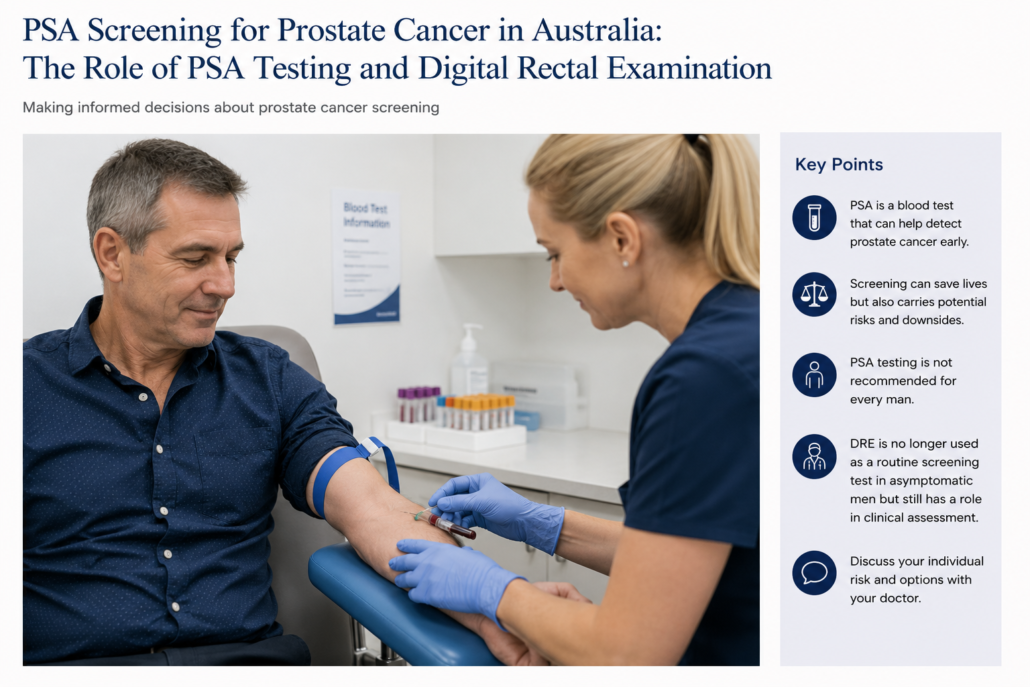
PSA Screening for Prostate Cancer in Australia: Should You Have a PSA Test?
Prostate cancer is one of the most commonly diagnosed cancers in Australian men. One of the difficulties with prostate cancer is that early prostate cancer usually causes no symptoms. By the time symptoms develop, some cancers may already have progressed beyond the prostate.
A simple blood test called the prostate-specific antigen (PSA) test can help identify men who may be at increased risk of prostate cancer. However, PSA testing is not a perfect cancer test and deciding whether to have regular PSA testing involves balancing the potential benefits of early diagnosis against the risks of unnecessary investigation and treatment.
In Australia, there is currently no national population-based prostate cancer screening program. Instead, PSA testing is based on an informed discussion between a man and his doctor, taking into account age, family history, overall health, life expectancy and personal preferences.

What is PSA?
PSA, or prostate-specific antigen, is a protein produced by prostate cells. A small amount normally enters the bloodstream and can be measured with a simple blood test.
An elevated PSA does not automatically mean that you have prostate cancer.
PSA can rise because of:
- prostate cancer
- benign enlargement of the prostate (BPH)
- inflammation or infection of the prostate
- urinary infection
- recent ejaculation or sexual activity
- recent instrumentation of the urinary tract
- manipulation of the prostate.
Conversely, some men with prostate cancer can have a PSA within the expected range. PSA is therefore best considered a marker of prostate activity and prostate cancer risk rather than a test that diagnoses cancer.
Who Should Consider PSA Testing in Australia?
Current Australian guidance supports informed, individualized PSA testing rather than universal population screening.
For men at average risk who have been informed about the potential benefits and harms and decide to undergo regular testing, current RACGP guidance recommends offering PSA testing every two years between the ages of 50 and 69 years.
Men with a significant family history may be advised to start earlier. Depending on the strength of the family history, testing may begin from approximately 40–45 years of age and continue every two years to age 69.
A stronger family history includes having a father, brother or multiple close relatives diagnosed with prostate cancer, particularly when prostate cancer occurred at a younger age.
Other factors, including ancestry, genetic predisposition and an individual’s general health and life expectancy, may also influence the decision about when to begin testing.
Importantly, these recommendations apply to men without symptoms. Men with symptoms or clinical findings that raise concern about prostate cancer require individual assessment rather than simply entering a screening program.
What Does an Elevated PSA Mean?
An elevated PSA is not a diagnosis of prostate cancer.
For men aged 50–69 undergoing early detection testing, a PSA above 3.0 ng/mL generally prompts further assessment under current Australian guidance. An abnormal result will often be repeated because PSA levels can fluctuate and temporary elevations are common.
Depending on the PSA level, age, prostate size, family history and other risk factors, further assessment may include:
Repeat PSA → assessment of PSA trend and other risk factors → specialist review → prostate MRI → possible prostate biopsy
Modern prostate cancer assessment has changed substantially. An abnormal PSA no longer necessarily means proceeding directly to a prostate biopsy. Multiparametric MRI (mpMRI) can help identify suspicious areas within the prostate and assist the urologist in deciding whether biopsy is necessary.
The Potential Benefits of PSA Screening
The principal advantage of PSA testing is straightforward:
It may detect a significant prostate cancer while it is still curable.
Aggressive prostate cancer can spread to lymph nodes, bones and other organs. Once metastatic prostate cancer develops, treatment is generally aimed at controlling rather than curing the disease.
Regular PSA testing provides an opportunity to identify some clinically important cancers years before they would otherwise become apparent.
Large screening trials have produced differing results, which is one reason PSA screening remains controversial. European screening data have demonstrated a reduction in prostate cancer mortality associated with PSA-based screening, while other trials have shown less convincing mortality benefits.
For an individual man, therefore, the potential benefit is significant: early detection may identify an aggressive cancer at a stage when curative treatment remains possible.
What Are the Downsides of PSA Screening?
The difficulty is that prostate cancer is not one disease.
Some prostate cancers are aggressive and potentially life-threatening. Others grow extremely slowly and may never cause symptoms during a man’s lifetime.
PSA testing can detect both.
False-positive PSA results
An elevated PSA may lead to anxiety, repeat blood tests, MRI scans and sometimes biopsy even when no cancer is ultimately found.
Overdiagnosis
PSA testing can identify a prostate cancer that would never have caused illness or shortened the man’s life.
This is known as overdiagnosis.
Overtreatment
If an insignificant cancer is diagnosed and subsequently treated, the man can potentially experience treatment complications without gaining a meaningful survival benefit.
Potential consequences of prostate cancer treatment include:
- erectile dysfunction
- urinary incontinence
- urinary symptoms
- ejaculatory changes
- bowel symptoms following some forms of radiotherapy.
This is one of the major reasons Australia does not currently have a universal PSA population-screening program.
Importantly, however, diagnosing prostate cancer does not automatically mean treating it.
Many men with low-risk prostate cancer are now managed with active surveillance, involving PSA monitoring, MRI and selective repeat biopsy. Treatment is reserved for evidence that the cancer is becoming more significant.
What Are the Implications of Not Having PSA Screening?
Choosing not to undergo PSA testing is also a legitimate decision, particularly after considering the benefits and disadvantages.
The advantage is avoiding the potential cascade of:
PSA testing → abnormal result → anxiety → MRI → biopsy → diagnosis of an insignificant cancer → possible unnecessary treatment.
However, there is another side to this decision.
Because early prostate cancer frequently produces no symptoms, a man who does not undergo PSA testing may remain unaware that he has prostate cancer.
For most men who never develop clinically significant disease, this causes no harm.
For a smaller group who develop aggressive prostate cancer, however, the first indication of the disease may occur after the cancer has grown substantially or spread beyond the prostate.
At that stage, the opportunity for curative treatment may have been reduced or lost.
The decision is therefore not simply:
“Do I want to know whether I have prostate cancer?”
A more useful question is:
“Given my age, health, family history and personal priorities, do the potential benefits of finding a significant prostate cancer early outweigh the potential harms of investigating and possibly diagnosing a cancer that may never affect me?”
This is why shared decision-making with your GP or urologist is important.
What About a Digital Rectal Examination?
The digital rectal examination, or DRE, involves a doctor gently inserting a gloved, lubricated finger into the rectum to examine the back surface of the prostate.
The doctor assesses the prostate for abnormalities such as:
- unusual hardness
- nodules
- asymmetry
- irregularity
- loss of the normal contour of the gland.
Historically, DRE was routinely combined with PSA testing for prostate cancer screening.
This has changed.
DRE is no longer recommended as a routine screening test in asymptomatic men
Current Australian guidance states that DRE should not routinely be added to PSA testing for early detection in asymptomatic men in primary care.
There are several reasons.
A finger can examine only part of the prostate. Small cancers may not be palpable, and cancers in areas of the prostate that cannot be reached during examination can be missed. A normal DRE therefore does not exclude prostate cancer.
Conversely, benign prostate enlargement and other abnormalities can sometimes produce an abnormal examination.
Does DRE Still Have a Role?
Yes.
Not recommending DRE as a routine screening test does not mean that the examination has become obsolete.
A urologist may perform a DRE when assessing a man with:
- an elevated or rising PSA
- urinary symptoms
- suspected prostate disease
- an abnormal MRI
- concern about locally advanced prostate cancer
- other pelvic or rectal symptoms.
Occasionally, a prostate cancer may produce a distinctly hard or irregular prostate even when the PSA is not dramatically elevated. An abnormal DRE can therefore remain clinically important and may prompt further investigation. Cancer Council Australia notes that urologists will commonly perform DRE as part of prostate assessment even though GPs no longer routinely use it for screening asymptomatic men.
The key distinction is:
DRE has a role in clinical examination and investigation, but it is not recommended as a routine population-screening test in an otherwise well man undergoing PSA testing.
PSA Screening Is About Risk, Not Just a Number
One of the most important changes in modern prostate cancer detection is moving away from treating PSA as simply “normal” or “abnormal.”
A PSA result should be interpreted in context.
Your doctor or urologist may consider:
your age + PSA level + change in PSA over time + family history + prostate size + symptoms + examination findings + MRI findings + overall health
Together, these provide a much more meaningful assessment of prostate cancer risk than a single PSA result.
Should I Have a PSA Test?
There is no single answer that is appropriate for every man.
For a healthy man in the appropriate age group, particularly someone with a family history of prostate cancer, the potential benefit of identifying an aggressive cancer while it remains curable may be important.
For an older man with substantial medical problems or limited life expectancy, the likelihood that PSA screening will provide meaningful benefit becomes considerably smaller. Current Australian guidance advises against PSA testing in men whose life expectancy is likely to be less than approximately seven years because a mortality benefit from early detection is unlikely to occur within that period.
The decision should therefore be individual rather than automatic.
The Bottom Line
PSA testing can save lives by detecting clinically significant prostate cancer at an earlier and potentially curable stage, but it can also detect cancers that would never have caused harm.
Australia therefore does not currently operate a universal PSA screening program. Instead, men are encouraged to make an informed decision about PSA testing after discussing their individual risk and the potential benefits and harms with their doctor.
For men who choose screening, current Australian guidance generally supports PSA testing every two years from age 50–69 for men at average risk, with earlier testing considered for men with a significant family history.
A digital rectal examination is no longer recommended as a routine addition to PSA screening in asymptomatic men, but it remains an important component of specialist prostate assessment in selected circumstances.
Concerned about your prostate cancer risk?
If you are considering PSA testing, have a family history of prostate cancer, have noticed a change in your PSA, or have urinary symptoms, discuss your individual risk with your GP or urologist.
Early detection should not simply be about finding more prostate cancers. The goal is to identify the cancers that matter, at a time when something useful can still be done about them.
This information is intended for general education and does not replace individual medical advice. Recommendations may differ according to your age, family history, medical conditions and previous PSA results.
Further information
Australian patient information and guidance are available from Cancer Council Australia: Prostate cancer screening and early detection and the RACGP Guidelines for preventive activities in general practice.








Leave a Reply
Want to join the discussion?Feel free to contribute!