
Hydrocoele in Younger Men: Causes, Fertility and Treatment Options
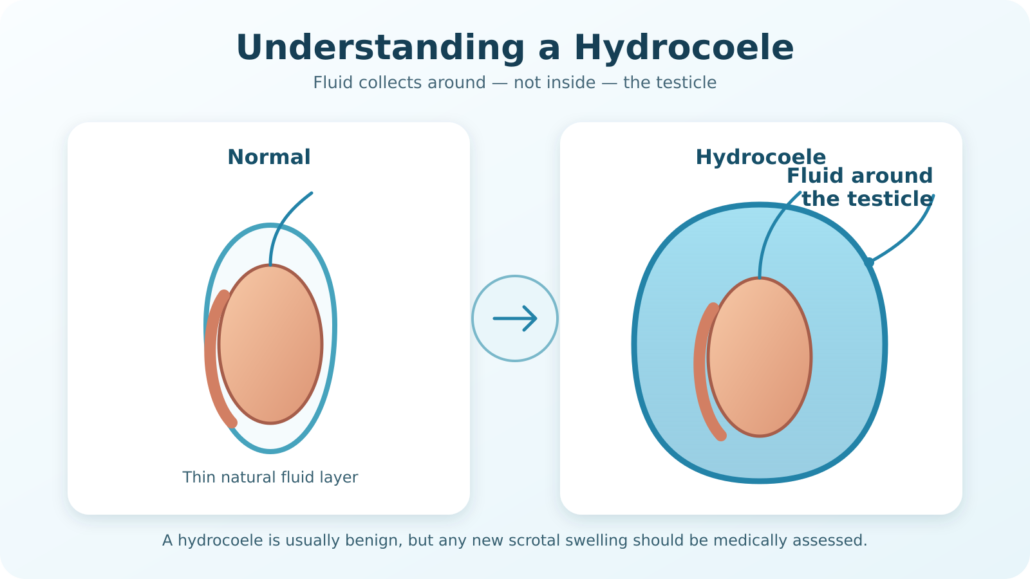
A hydrocoele is a collection of clear fluid around the testicle. It usually causes a painless swelling on one side of the scrotum, although both sides can occasionally be affected.
Hydrocoeles are common in babies and older men, but they can also develop during adolescence or young adulthood. In a younger man, the important question is not only “Is this a hydrocoele?” but also “Why has it developed?”
Most hydrocoeles are benign and do not threaten the testicle. Nevertheless, any new scrotal swelling should be examined because conditions such as an inguinal hernia, infection, testicular torsion or testicular tumour can sometimes produce a similar appearance or cause a secondary hydrocoele.
What causes a hydrocoele?
The testicle is partly surrounded by a thin membrane called the tunica vaginalis. This membrane normally produces a small amount of lubricating fluid, which is continually reabsorbed. A hydrocoele develops when fluid production exceeds absorption.
In younger men, possible causes include:
- Idiopathic hydrocoele: No specific cause is identified. This is common.
- Persistent communication with the abdomen: A small channel through which the testicle descended before birth may remain open. This is more typical in children but can occasionally persist into young adulthood and may be associated with an inguinal hernia.
- Inflammation or infection: Epididymitis, orchitis and some sexually transmitted infections may cause fluid to collect around the testicle.
- Trauma: A sporting injury, direct blow or previous scrotal injury can lead to a reactive hydrocoele.
- Previous surgery: Hydrocoeles may occasionally follow groin, hernia, varicocele or testicular surgery.
- Testicular torsion: Twisting of the spermatic cord can produce a reactive hydrocoele, although severe sudden pain is normally the dominant symptom.
- Testicular tumour: A tumour may occasionally be accompanied by a hydrocoele. The hydrocoele itself is not cancer, but the fluid can make examination of the underlying testicle difficult.
What does a hydrocoele feel like?
A typical hydrocoele produces a smooth, soft or tense swelling around the testicle. It may fluctuate in size and often feels heavier as it enlarges.
Symptoms can include:
- painless scrotal enlargement;
- a dragging or heavy sensation;
- discomfort when walking, running or exercising;
- irritation from clothing;
- difficulty examining the testicle;
- embarrassment or concern about appearance; and
- discomfort during sexual activity.
A very large hydrocoele can become inconvenient and may interfere with sport, work or everyday activities.
When is urgent assessment needed?
A hydrocoele usually develops gradually and is not an emergency. Seek urgent medical care, however, if there is:
- sudden or severe testicular pain;
- rapid swelling;
- nausea or vomiting with scrotal pain;
- redness, fever or increasing tenderness;
- a hard lump within the testicle;
- scrotal swelling following a significant injury; or
- a swelling that cannot be pushed back and is associated with groin or abdominal pain.
Sudden testicular pain may represent torsion, in which the blood supply to the testicle becomes twisted. This requires emergency assessment and should never be attributed to “just a hydrocoele.”
How is a hydrocoele diagnosed?
Assessment usually begins with a discussion about how and when the swelling developed, followed by examination of the abdomen, groin and scrotum.
A hydrocoele may transmit light when a torch is placed behind it, a finding called transillumination. This can support the diagnosis, but it does not replace a proper examination.
A scrotal ultrasound is commonly arranged in a younger man, particularly when:
- the hydrocoele is new;
- the testicle cannot be examined clearly;
- there is pain or tenderness;
- the swelling developed after injury;
- the diagnosis is uncertain; or
- an underlying testicular abnormality needs to be excluded.
Ultrasound can confirm that the swelling contains fluid and assess the testicle, epididymis, blood flow and surrounding structures. The European Association of Urology recommends high-frequency ultrasound when investigating a suspected testicular mass because it can determine whether a lesion is inside or outside the testicle and assess the opposite testis. EAU Testicular Cancer Guideline
Urine tests, STI testing or blood tests may also be appropriate when infection or inflammation is suspected.
Can a hydrocoele affect fertility?
For most younger men, a small or moderate uncomplicated hydrocoele does not cause infertility. It does not normally block sperm transport and does not automatically mean that sperm production is abnormal.
There are, however, several important qualifications:
- The underlying cause may matter more than the fluid.
Previous torsion, testicular trauma, severe infection, an undescended testicle, testicular cancer or another testicular disorder may affect fertility independently of the hydrocoele. - A very large or tense hydrocoele may theoretically affect the testicle.
Prolonged pressure or increased local temperature has been proposed as a possible mechanism for impaired testicular function. Evidence in adults remains limited, and clinically significant infertility from an isolated hydrocoele appears uncommon. - Surgery carries a small fertility-related risk.
Hydrocoele repair is performed close to the epididymis, vas deferens and testicular blood supply. Injury to one of these structures is uncommon but could affect fertility, particularly when operating on both sides or when the opposite testicle is abnormal. The British Association of Urological Surgeons lists inadvertent injury to these structures as an uncommon recognised complication of surgery. BAUS hydrocoele repair information
A semen analysis is not routinely required for every man with a hydrocoele. It may be appropriate when:
- a couple has been unable to conceive;
- the hydrocoele is very large or present on both sides;
- the opposite testicle is small or abnormal;
- there is a history of undescended testis, torsion, chemotherapy, testicular surgery or significant infection; or
- fertility preservation is an important concern before surgery.
The EAU recommends that the assessment of male infertility include a reproductive and medical history, physical examination, semen analysis and, where indicated, hormonal tests and imaging. It also stresses that semen analysis must be interpreted as part of the couple’s overall reproductive assessment rather than as a simple “fertile or infertile” test. EAU Male Infertility Guideline
Does every hydrocoele need treatment?
No. Treatment depends on the cause, size, symptoms and effect on quality of life.
Observation
A small, painless hydrocoele with a normal underlying testicle can often be monitored. It does not need to be removed merely because it is present.
Observation may include:
- self-awareness of any change in size or consistency;
- periodic clinical review when appropriate; and
- reassessment if pain, rapid enlargement or a new lump develops.
The British Association of Urological Surgeons supports observation when an adult hydrocoele is small or not bothersome. BAUS
Treating an underlying cause
If the fluid is secondary to infection, inflammation or another condition, treatment should address that cause. The hydrocoele may reduce once the underlying problem settles, although established hydrocoeles do not always disappear.
Aspiration
Aspiration involves inserting a needle and draining the fluid. Although this can provide temporary relief, the fluid usually returns because the lining that produces it remains in place.
Aspiration also carries risks of bleeding and infection. BAUS does not regard aspiration alone as curative or standard treatment because recurrence is common. It may occasionally be considered for someone who is unsuitable for surgery. In selected circumstances, a sclerosant may be injected after aspiration, but recurrence and inflammation remain concerns.
Hydrocoelectomy
Hydrocoelectomy is the most reliable definitive treatment for a bothersome adult hydrocoele. Surgery may be considered when the swelling:
- is large or progressively enlarging;
- causes discomfort, heaviness or skin irritation;
- interferes with exercise, work or sexual activity;
- causes significant cosmetic or psychological concern; or
- makes examination of the testicle difficult.
The operation is generally performed through a small scrotal incision under general or spinal anaesthesia. The fluid is drained, and the fluid-producing sac is folded, turned behind the testicle or partly removed to reduce the likelihood of recurrence.
Most procedures are performed as day surgery.
What should you expect after surgery?
Bruising, swelling and discomfort are expected and may initially make the scrotum look larger rather than smaller. Supportive underwear, simple pain relief and protected ice packs can help during the early recovery period.
Strenuous exercise and heavy lifting are generally avoided for several weeks. The testicle may continue to feel somewhat bulkier after repair because of the folded or thickened tissues around it.
Possible complications include:
- bleeding or a scrotal haematoma;
- wound or testicular infection;
- persistent swelling;
- recurrence of the hydrocoele;
- chronic scrotal discomfort;
- anaesthetic complications; and
- uncommon injury to the epididymis, vas deferens or testicular blood supply.
The current BAUS patient information notes that temporary bruising and swelling are very common, while infection, haematoma, recurrence and injury to adjacent reproductive structures occur much less often. Individual risks depend on the size and complexity of the hydrocoele, previous surgery, infection and general health. BAUS hydrocoele repair leaflet
The important message for younger men
A hydrocoele is usually harmless, and many do not require treatment. However, a new scrotal swelling in a younger man should not be self-diagnosed or ignored. Clinical examination and often an ultrasound can confirm the diagnosis and ensure that the testicle underneath is healthy.
Most isolated hydrocoeles do not impair fertility. When fertility is a concern, the entire reproductive history and both testicles should be assessed rather than assuming that the hydrocoele is responsible.
Management should be individualised. For one man, reassurance and observation may be entirely appropriate. For another, surgery may provide worthwhile relief from heaviness, discomfort or embarrassment.
This article provides general patient information and does not replace individual medical assessment. Seek urgent care for sudden testicular pain, rapid swelling, fever or a hard testicular lump.
So, if you have noted a scrotal swelling and this is concerning you and need to have this checked out, see your GP or obtain a referral to see you Brisbane Urologist, Uro-Jo, for peace of mind.






Leave a Reply
Want to join the discussion?Feel free to contribute!