
Focal Therapy for Prostate Cancer: Targeting the Cancer While Preserving the Prostate
Established management of localised prostate cancer includes active surveillance for suitable low-risk disease and whole gland treatment with surgery or radiotherapy when treatment is indicated. ProFocal® is a newer focal approach that uses laser energy to destroy a selected cancerous area while leaving much of the surrounding prostate untreated.
This approach is known as focal laser therapy or focal laser ablation. Its intended aim is to control the treated cancer focus while reducing urinary and sexual side effects. Whether it provides cancer control equivalent to established whole-gland treatments over the long term has not been demonstrated.
Early Australian research is encouraging. However, ProFocal remains an investigational treatment, and important questions about its long-term cancer control have not yet been answered.
What is ProFocal therapy?
ProFocal is an Australian-developed focal therapy system designed to treat a carefully selected area of prostate cancer.
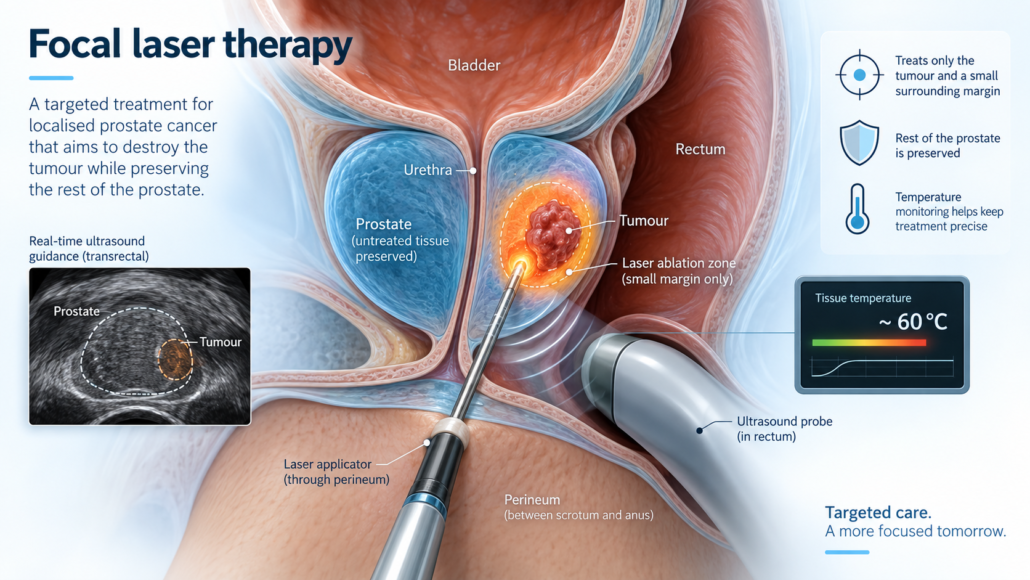
A fine laser applicator is inserted through the skin between the scrotum and anus, the perineum, and guided into the prostate using imaging. Laser energy heats the targeted tissue to a temperature that causes cancer-cell death.
The system incorporates cooling and real-time temperature monitoring. This is intended to make the area of ablation more predictable and to limit unintended heat damage to nearby structures such as the:
- Urinary sphincter
- Urethra
- Bladder neck
- Rectum
- Neurovascular bundles involved in erections
Unlike radical prostatectomy, ProFocal does not remove the prostate. Unlike conventional radiotherapy, it does not expose the whole prostate to radiation.
Is ProFocal approved by the TGA?
This requires careful clarification.
As at September 2026, the manufacturer states that ProFocal is not included in the Australian Register of Therapeutic Goods, ARTG. It therefore does not have general TGA market authorisation for routine supply and use in Australia.
This is different from saying that the treatment has received unrestricted “TGA approval.”
ProFocal may be accessible in Australia through a clinical trial or a specific TGA pathway for an unapproved therapeutic good, such as the Authorised Prescriber Scheme or Special Access Scheme. These pathways permit access in defined circumstances; they are not equivalent to ARTG inclusion or routine TGA market authorisation. The applicable approval, governance and consent arrangements should be confirmed for the individual patient.
Authorised Prescriber access does not mean that the device has been entered on the ARTG or endorsed as routine standard treatment. Regulatory status, trial availability and funding arrangements should always be confirmed directly before treatment.
Medicare, private insurance and professional oversight in Australia
The Medicare Benefits Schedule (MBS) lists professional medical services subsidised by the Australian Government. As at September 2026, no specific MBS item for “ProFocal” or focal laser ablation of prostate cancer was identified in the current public MBS material reviewed for this article. This should not be interpreted as a definitive ruling on every component of an episode of care: consultations, anaesthesia, imaging, pathology or hospital services may each have different billing arrangements.
An MBS rebate for an associated service would not establish that ProFocal itself is TGA-approved, guideline-endorsed or proven effective. Conversely, lawful access through a TGA pathway does not guarantee Medicare or private-insurance funding. The Department of Health and Aged Care’s Medical Services Advisory Committee (MSAC) is the independent body that advises government on whether public funding of medical services and technologies is supported by evidence of safety, clinical effectiveness and cost-effectiveness.
The Australian Medical Association (AMA) is a professional representative body, not the regulator of therapeutic goods and not the agency that creates Medicare items. No AMA clinical guideline specifically recommending ProFocal was identified for this review. It would therefore be inappropriate to imply AMA endorsement. Relevant professional duties instead arise from the Medical Board of Australia’s code of conduct: patients should receive understandable information about the proposed treatment, reasonable alternatives, material risks, uncertainties, costs and any practitioner conflicts of interest so that consent is genuinely informed.
Who may be considered for ProFocal therapy?
ProFocal is principally being studied in men with localised, non-metastatic and MRI-visible prostate cancer.
In the first prospective phase II ProFocal study, eligible men had:
- Prostate cancer confined to the prostate
- An MRI-visible cancer target
- ISUP Grade Group 2 or 3 disease
- A PSA of 15 ng/mL or lower
- A clinical stage of T2c or lower
- Biopsy findings corresponding with the abnormality seen on MRI
Outside a clinical trial, suitability would need to be assessed individually by a multidisciplinary prostate cancer team.
A potential candidate generally requires a cancer that can be clearly identified, biopsied and safely surrounded by an adequate treatment margin. Detailed assessment usually includes:
- Multiparametric prostate MRI
- Targeted and systematic transperineal biopsies
- PSA and PSA-density assessment
- Clinical staging
- Consideration of PSMA PET/CT in selected men
- Review of the MRI and pathology at a multidisciplinary meeting
When may ProFocal be unsuitable?
ProFocal would generally not be considered appropriate when there is:
- Metastatic prostate cancer
- High-risk or locally advanced disease requiring comprehensive treatment
- Cancer outside the prostate
- Extensive cancer involving several areas of the gland
- Cancer that cannot be reliably identified on MRI
- A tumour position where an adequate and safe treatment margin cannot be achieved
- Significant uncertainty about the true extent or grade of the cancer
- An inability or unwillingness to undergo ongoing MRI scans and repeat biopsies
- A medical condition that makes anaesthesia or the procedure unacceptably risky
Men with low-risk Grade Group 1 prostate cancer may be better managed with active surveillance, avoiding treatment and its potential complications altogether.
Focal therapy should not be regarded as an easier substitute for appropriate surgery or radiotherapy in men with aggressive, high-volume or advanced prostate cancer.
How is ProFocal treatment performed?
ProFocal is usually performed as a day procedure under general anaesthesia.
Treatment planning
The cancer identified on MRI and biopsy is mapped carefully. The treatment plan includes the visible tumour and an additional safety margin intended to treat microscopic cancer immediately around it.
Placement of the laser applicator
With the patient under anaesthesia, a transrectal ultrasound probe is used to visualise the prostate. A fine laser applicator is inserted through the perineum and positioned within the selected treatment area.
The route is similar to that used for a transperineal prostate biopsy.
Laser ablation
Controlled laser energy heats and destroys the targeted prostate tissue. Temperature monitoring helps the surgeon assess treatment delivery and protect surrounding structures. More than one applicator position may be needed to cover the planned treatment zone.
The published phase II study reported a median treatment time of approximately 60 minutes, although the complete anaesthetic and theatre procedure may take longer.
Recovery
A urinary catheter may be required temporarily because prostate swelling can make urination difficult. Many patients can return home on the day of treatment or after a short admission, depending on their recovery and ability to pass urine.
What are the potential advantages?
The proposed advantages of ProFocal include:
- Treatment directed at the known cancer rather than the whole prostate
- No abdominal incision
- A transperineal, minimally invasive approach
- Short hospital stay
- Faster initial recovery than major surgery
- No ionising radiation
- Preservation of untreated prostate tissue
- A potentially lower risk of persistent urinary incontinence
- A potentially lower risk of erectile dysfunction than whole gland treatment
- The possibility of further focal or whole-gland treatment if cancer remains or returns
These are potential benefits and should not be interpreted as guarantees.
How does it compare with established alternatives?
There is no mature randomised evidence showing that ProFocal gives the same long-term protection from metastasis or prostate-cancer death as radical prostatectomy or radiotherapy. A balanced consultation should therefore compare all reasonable options:
- Active surveillance: avoids or delays treatment side effects and is preferred for many men with low-risk disease, but requires PSA testing, MRI and repeat biopsy, with treatment if the cancer progresses.
- Radical prostatectomy: removes the prostate and provides complete surgical pathology. It has long-term cancer-control data, but carries risks including urinary incontinence, erectile dysfunction, loss of ejaculation and surgical complications.
- Radiotherapy: has established long-term cancer-control data and avoids surgery, but may cause urinary, bowel and sexual adverse effects; androgen-deprivation therapy may be advised for some risk groups.
- ProFocal/focal laser ablation: may offer quicker recovery and less short-term urinary or sexual morbidity for carefully selected men, but leaves untreated prostate tissue, requires MRI and repeat-biopsy surveillance, and has uncertain long-term comparative cancer-control outcomes.
The most appropriate option depends on cancer grade, volume and location; PSA and stage; age and general health; baseline urinary and sexual function; personal priorities; and willingness to accept surveillance or treatment uncertainty. A multidisciplinary opinion and, where useful, separate discussions with a urologist and radiation oncologist can reduce treatment-selection bias.
What did the early ProFocal study find?
The first published phase II trial included 100 men with localised, MRI-visible Grade Group 2 or 3 prostate cancer.
At the three-month biopsy:
- 84% had no clinically significant Grade Group 2 or higher cancer within the treated area
- Approximately 16% therefore had residual clinically significant cancer within the treatment zone
- Erectile dysfunction was reported in 12%
- The average sexual-function scores decreased by approximately 15%
- Urinary-domain scores decreased by approximately 4.5%
- No significant deterioration was reported in the other measured functional outcomes
These results are promising, but they represent very early follow-up. The study had no surgery, radiotherapy or active surveillance control group. It therefore cannot establish whether ProFocal provides equivalent long-term protection against recurrence, metastasis or death from prostate cancer.
Possible side effects and complications
Short-term effects may include:
- Bruising or discomfort in the perineum
- Blood in the urine
- Blood in the semen
- Burning or discomfort when urinating
- Urinary frequency or urgency
- Temporary difficulty passing urine
- Temporary catheterisation
- Urinary tract infection
- Pelvic or rectal discomfort
- Fatigue following anaesthesia
Potential longer-term or less common problems include:
- New or worsening erectile dysfunction
- Reduced ejaculatory volume
- Retrograde ejaculation
- Urinary incontinence
- Urethral or bladder-neck scarring
- Persistent urinary symptoms
- Damage to tissue outside the intended treatment zone
- Infection or abscess
- A fistula involving the urinary tract and rectum, expected to be rare
- Incomplete cancer treatment
- Cancer developing or becoming apparent elsewhere in the untreated prostate
- A requirement for repeat focal therapy, radiotherapy or radical prostatectomy
The risk of sexual or urinary dysfunction depends partly on the size and location of the tumour. A lesion near the neurovascular bundles, urethra, urinary sphincter or bladder neck may be more difficult to treat without affecting function.
The untreated prostate remains important
Prostate cancer is frequently multifocal, meaning that separate areas of cancer may exist within the same prostate. MRI is very useful but cannot detect every small or biologically significant tumour.
ProFocal treats the selected target, not every prostate cell.
This creates two possible patterns of treatment failure:
- In-field disease: cancer remains or returns inside the treated area.
- Out-of-field disease: cancer is subsequently found elsewhere in the untreated prostate.
A successful early scan does not prove that all clinically significant cancer has been eliminated.
Follow-up after ProFocal therapy
Follow-up is more intensive than simply checking the PSA.
Because the prostate remains in place, PSA will not normally fall to an undetectable level. There is also no universally accepted PSA threshold that defines successful focal treatment or recurrence.
Follow-up may include:
- Regular PSA testing
- Clinical review and symptom assessment
- Multiparametric MRI
- Quality-of-life and erectile function assessment
- Repeat targeted biopsy of the treated area
- Systematic biopsy of the untreated prostate
- Additional imaging when recurrence is suspected
The Prostate Cancer Foundation of Australia cautions that PSA testing alone is not sufficient to exclude recurrent cancer after focal therapy. Patients must be willing to undergo long-term imaging and, when recommended, further prostate biopsies.
Can treatment be repeated?
Repeat focal treatment may be possible when residual or recurrent cancer remains localised and clearly targetable.
Depending on the findings, subsequent options may include:
- Repeat focal ablation
- Radical prostatectomy
- External-beam radiotherapy
- Another focal therapy technique
- Active surveillance for selected low-volume disease
- Systemic treatment if the cancer has spread
Salvage surgery or radiotherapy may still be possible after focal therapy, but treatment can sometimes be technically more complex because of scarring and tissue changes. The likely salvage options should therefore be discussed before proceeding with ProFocal.
Important limitations
Patients considering ProFocal should understand that:
- ProFocal is not currently included on the Australian ARTG
- It is not established as routine standard-of-care treatment
- Published ProFocal evidence currently comes from a small number of men
- The pivotal study was single-arm and had very short follow-up
- Long-term rates of metastasis-free, cancer-specific and overall survival are unknown
- There are no mature randomised comparisons with prostatectomy, radiotherapy or modern active surveillance
- Approximately 16% of men in the initial study had clinically significant cancer remaining in the treated area at three months
- Cancer may be missed elsewhere in the prostate
- Repeat MRI scans and biopsies are required
- Further cancer treatment may be needed
- Access may be limited to trials or special regulatory pathways
- Medicare or private health insurance may not cover treatment or follow-up costs
What do Australian and international guidance sources say?
The Prostate Cancer Foundation of Australia (PCFA) describes focal therapies as emerging and experimental. It notes that focal treatment may reduce side effects but that the prostate remains in place, PSA monitoring is less straightforward, and ongoing MRI and biopsy are required.
Australian evidence-based resources regard active surveillance, radical prostatectomy and radiotherapy as established pathways for appropriately selected localised disease. ProFocal has not yet acquired the same evidence base or standard-of-care status. The absence of a treatment-specific recommendation should not be reframed as support.
The European Association of Urology (EAU) states that focal therapy has favourable functional outcomes but that definitive evidence of long-term oncological benefit remains unavailable. Its guideline recommends focal HIFU or cryotherapy only within a prospective registry and other ablative methods—including focal laser therapy—only within a well-designed prospective clinical trial.
The American Urological Association and American Society for Radiation Oncology advise clinicians that comparative evidence for focal ablation is lacking and that patients must be informed that further treatment may be required. Focal or whole-gland ablation should not be offered for high-risk prostate cancer outside a clinical trial.
The UK National Institute for Health and Care Excellence (NICE) guidance for focal HIFU and focal cryoablation—not ProFocal specifically—also emphasises special governance, consent, audit/research arrangements and uncertainty about long-term cancer control. This is relevant context for focal therapy but must not be represented as device-specific approval of ProFocal.
The Prostate Cancer Foundation of Australia similarly describes focal therapies as experimental and emphasises the need for continuing MRI, biopsies and careful long-term monitoring.
The bottom line
ProFocal is an Australian-developed investigational technology that may eventually provide selected men with an additional option between surveillance and whole-gland treatment.
Its early results suggest that precisely delivered cooled laser therapy can destroy an MRI-visible prostate cancer target with relatively limited short-term urinary morbidity. However, early cancer clearance is not the same as proven long-term cancer control.
At present, ProFocal should be considered an investigational focal therapy. Consistent with current guidance for focal laser ablation, its most defensible use is within a well-designed prospective clinical trial with ethics and regulatory oversight, multidisciplinary assessment, explicit informed consent, independent outcome reporting and mandatory long-term follow-up.
The decision should be made only after comparing ProFocal with all appropriate alternatives, including active surveillance, radical prostatectomy and radiotherapy.
This article provides general information and does not replace individual medical advice. Regulatory status and treatment availability can change and should be confirmed at the time of consultation.
References and further reading
-
- Therapeutic Goods Administration—Australian Register of Therapeutic Goods
- Therapeutic Goods Administration—Accessing unapproved products
- Australian Government—Medicare Benefits Schedule Online
- Medical Services Advisory Committee—Role and assessment process
- Medical Board of Australia—Good medical practice: a code of conduct for doctors in Australia
- Australian Medical Association—Code of Ethics
- Medlogical Innovations—ProFocal regulatory and clinical information
- Kam J, et al. Focal therapy using a novel cooled laser device for prostate cancer: early trial results. BJU International, 2026
- European Association of Urology—Prostate Cancer Guidelines: Treatment
- American Urological Association/ASTRO—Clinically Localized Prostate Cancer Guideline
- Prostate Cancer Foundation of Australia—Focal Therapy
- Cancer Council Australia—Clinical practice guidelines and resources
- NICE—Focal therapy using high-intensity focused ultrasound for localised prostate cancer (IPG756)
- NICE—Focal therapy using cryoablation for localised prostate cancer (IPG757)
- Australian New Zealand Clinical Trials Registry—PROFIRE ProFocal trial






Leave a Reply
Want to join the discussion?Feel free to contribute!