
Post-Prostatectomy Urinary Incontinence
/0 Comments/in Blog Post, Incontinence Surgery/by drjoWhen urine leakage persists after prostate surgery
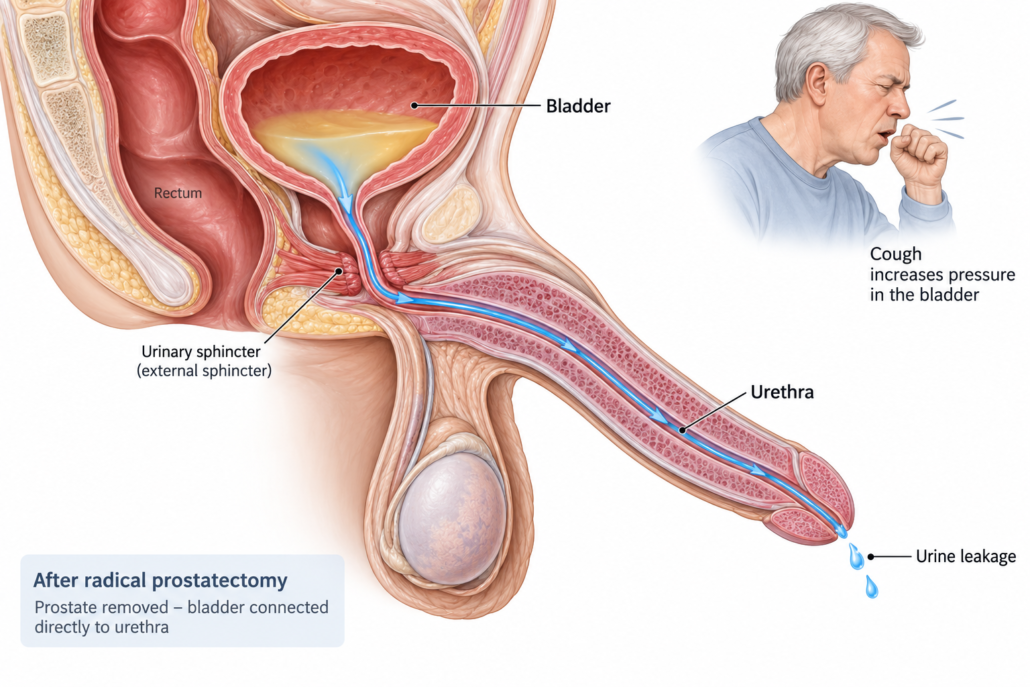
Urinary leakage after prostatectomy is common, particularly in the first few weeks and months following surgery. For most men, bladder control progressively improves as the urinary sphincter and pelvic floor recover.
For some men, however, leakage persists and can become a significant physical, social and emotional burden.
The good news is that persistent post-prostatectomy urinary incontinence is treatable, and there are several options ranging from pelvic floor rehabilitation through to highly effective surgical treatments.
What is post-prostatectomy incontinence?
Post-prostatectomy urinary incontinence (PPI) refers to involuntary leakage of urine following surgery to remove the prostate, most commonly radical prostatectomy for prostate cancer.
The most common form is stress urinary incontinence (SUI).
You may notice leakage when:
- Coughing or sneezing
- Standing up
- Walking or exercising
- Lifting something heavy
- Getting out of a chair or car
- Bending over
- Playing sport
- During sexual activity or orgasm
Some men also experience urgency urinary incontinence, where a sudden compelling desire to urinate is followed by leakage.
Others have a combination of stress and urgency incontinence.
Why does this happen?
The prostate sits immediately below the bladder and surrounds the urethra. The urinary sphincter mechanism is therefore intimately involved with prostate surgery.
After prostatectomy, continence depends on the remaining external sphincter, pelvic floor muscles and the way the bladder stores and releases urine.
Recovery is a process rather than an on/off switch.
Most men experience substantial improvement during the first year, although the rate and extent of recovery varies between individuals. A small proportion of men continue to have bothersome leakage that requires active treatment.
How severe is the leakage?
The first step is to understand exactly what type of leakage you have and how much urine you are losing.
A consultation should look at:
1. Your symptoms
We want to know:
- When did the leakage begin?
- Is it improving, stable or getting worse?
- Does it occur with coughing, movement or exercise?
- Do you experience urgency?
- How frequently do you urinate?
- Do you get up at night?
- Do you have difficulty emptying your bladder?
- Do you leak during sexual activity or orgasm?
- How much does the problem interfere with your lifestyle?
A validated questionnaire such as the ICIQ-UI Short Form can provide a standardised measure of symptoms and their impact.
Objective assessment
It is useful to measure your incontinence rather than relying solely on how many pads you use.
Different men use different numbers of pads, and a pad that is changed for comfort may contain very little urine.
Pad weight testing
A pad weight test provides a more objective measurement of urine loss.
The principle is simple:
1 gram increase in pad weight ≈ 1 mL of urine.
Depending on the clinical question, testing can be performed over a defined period or as a 24-hour pad weight assessment during normal daily activities.
For example:
Dry pads: 250 g
Used pads: 650 g
Urine loss = 400 g ≈ 400 mL
Pad testing can help:
- Quantify the severity of leakage
- Establish a baseline
- Monitor improvement
- Compare the result before and after treatment
Pad weight testing is recommended as one of the objective tools for assessing male urinary incontinence.
Why pad weight can be more useful than “number of pads”
One man’s “three pads a day” may represent a few drops on each pad.
Another man’s three pads may be completely saturated.
The number of pads therefore tells only part of the story.
The weight tells us how much urine is actually being lost.
Bladder diary
A 3-day bladder diary can be remarkably informative.
You record:
- What and how much you drink
- Time of each drink
- Time of each urination
- Volume passed
- Urgency
- Episodes of leakage
- Activity associated with leakage
- Pad changes
- Night-time urination
The diary helps identify patterns that may not be obvious during a consultation.
It can distinguish, for example, between:
“I am leaking because my sphincter is weak”
and
“I am leaking because my bladder is filling rapidly and becoming overactive.”
Bladder diaries are an established method for objectively assessing frequency, voided volumes, urine production and urinary leakage.
Ultrasound assessment
An ultrasound examination can provide important additional information.
A particularly useful measurement is the post-void residual (PVR).
This tells us how much urine remains in the bladder after you have urinated.
Why does this matter?
Persistent urine in the bladder may indicate:
- Poor bladder emptying
- Bladder outlet obstruction
- Reduced bladder contractility
- Dysfunctional voiding
Ultrasound may also be used to assess the urinary tract and, where clinically appropriate, investigate other anatomical abnormalities.
Measurement of PVR is recommended in the assessment of male urinary incontinence.
Urodynamic testing
Sometimes the bladder and sphincter need to be examined in considerably more detail.
This is where urodynamics can be extremely useful.
Urodynamic testing measures how the bladder and urethra behave during filling and emptying.
It can assess:
- Bladder capacity
- Bladder sensation
- Bladder compliance
- Detrusor overactivity
- Bladder pressure
- Urinary flow
- Bladder emptying
- Sphincter function
- Stress leakage
- Bladder outlet obstruction
Why is this important?
Not all post-prostatectomy leakage is caused by the same problem.
A man may have:
Sphincter weakness
or
Overactive bladder
or
Poor bladder compliance
or
Impaired bladder contractility
or a combination of these.
Urodynamics can help distinguish bladder dysfunction from sphincteric insufficiency and can be particularly useful when the diagnosis is uncertain, bladder emptying is abnormal, or invasive treatment is being considered.
Urodynamics is not necessarily required for every man with straightforward stress incontinence.
It should be used selectively when the results are likely to influence diagnosis, counselling or treatment.
Pelvic floor muscle training
The pelvic floor is part of your continence mechanism
Pelvic floor muscle training (PFMT) is an important component of recovery after prostatectomy.
The pelvic floor muscles help support the urethra and contribute to urinary control.
The aim is not simply to perform hundreds of random “Kegels”.
Effective rehabilitation involves learning to:
- Identify the correct muscles
- Contract them correctly
- Hold the contraction
- Relax completely
- Coordinate the contraction with movement and changes in abdominal pressure
- Use the muscles appropriately during activities that trigger leakage
A specialised pelvic floor physiotherapist can be extremely helpful.
Timing matters
Pelvic floor exercises can be started before prostatectomy and should be continued after surgery.
Following catheter removal, pelvic floor muscle exercises or formal pelvic floor muscle training should be offered to men recovering from radical prostatectomy. Evidence suggests that they can accelerate the return of continence, particularly during the earlier stages of recovery.
However, pelvic floor exercises are not a magic switch.
If significant stress incontinence persists despite appropriate rehabilitation, it is important to reassess the situation rather than simply continuing exercises indefinitely.
When should surgery be considered?
Continence often continues to improve during the first year after prostatectomy.
For men with bothersome stress urinary incontinence who are not improving despite conservative treatment, surgical treatment can be considered from around six months, particularly when the incontinence is severe.
For persistent bothersome incontinence, surgical treatment should generally be offered by approximately 12 months rather than waiting indefinitely for further spontaneous improvement.
The exact timing should be individualised.
Surgical treatment
There is no single operation that is right for every man.
The choice depends on:
- Severity of leakage
- Pad weight
- Time since prostatectomy
- Previous radiation therapy
- Urethral anatomy
- Bladder function
- Previous continence surgery
- Manual dexterity
- Patient expectations and preferences
The major surgical options include:
1. Male sling
A male sling supports and/or repositions the urethra to improve urinary control.
It is generally most suitable for mild to moderate stress urinary incontinence.
A sling may be particularly attractive to men who:
- Have relatively low-volume leakage
- Have not received pelvic radiation
- Have good bladder function
- Prefer a treatment without a mechanical pump
However, male slings are not routinely recommended for severe stress incontinence, where outcomes are generally less reliable than with an artificial urinary sphincter.
2. Artificial urinary sphincter
For significant or severe post-prostatectomy stress incontinence, the artificial urinary sphincter (AUS) remains the benchmark surgical treatment.
The device consists of:
- A cuff around the urethra
- A small control pump in the scrotum
- A pressure-regulating balloon
When the cuff is inflated, the urethra is closed.
When you want to urinate, you squeeze the pump.
The cuff temporarily opens, allowing urine to pass.
It then automatically closes again.
Who is an AUS suitable for?
An AUS can be considered for men with mild through severe stress urinary incontinence, particularly when conservative treatment has failed.
Before implantation, the patient needs sufficient manual dexterity and cognitive ability to operate the device.
What are the disadvantages?
An AUS is a mechanical implant.
Potential complications include:
- Infection
- Urethral erosion
- Mechanical failure
- Persistent or recurrent leakage
- Urethral atrophy
- Need for revision or replacement
The device can provide excellent long-term continence, but patients should understand that it is not necessarily a “fit it and forget it” solution. Reoperations become more common as the device ages.
3. Adjustable continence devices
Adjustable balloon systems are another option in selected men.
These devices provide external compression around the urethra and can be adjusted following implantation.
They may be considered in selected patients, particularly those with mild incontinence and appropriate anatomy.
The evidence base is less extensive than that for the AUS, and device complications and explantation need to be discussed carefully.
4. Urethral bulking injections
Injectable bulking agents have historically been used to try to improve urethral closure.
They are minimally invasive, but their effectiveness in men following prostatectomy is limited.
Patients should understand that cure is uncommon and durability is poor compared with established surgical treatments.
They are therefore not generally considered the preferred treatment for significant post-prostatectomy stress incontinence.
What if you have urgency as well?
Not every leak after prostatectomy is caused by the sphincter.
Some men develop overactive bladder symptoms, including:
- Urgency
- Frequency
- Nocturia
- Urgency-associated leakage
This may require treatment directed at the bladder rather than the sphincter.
Treatment may include:
- Bladder training
- Fluid modification
- Pelvic floor rehabilitation
- Medication
- Selected minimally invasive treatments for overactive bladder
If urgency is the dominant problem, it should be treated as an overactive bladder rather than assuming that an operation on the sphincter will solve everything.
What about men who have had radiotherapy?
Previous pelvic radiotherapy is particularly important when choosing surgery.
Radiation can affect the tissues and urethral blood supply and may increase the risk of complications and treatment failure.
For men with stress incontinence following radiotherapy, an artificial urinary sphincter is generally preferred over a male sling or adjustable balloon device.
This is one reason why your previous prostate cancer treatment is an important part of the surgical decision.
The decision is about more than pads
The goal of treatment is not simply:
“How many pads can we get you down to?”
It is about getting you back to the life you want to live.
That might mean being able to:
- Exercise without worrying about leakage
- Play golf or tennis
- Go out without carrying spare pads
- Travel confidently
- Sleep without constantly worrying about leakage
- Wear the clothes you want
- Be intimate with your partner without anxiety
The appropriate treatment depends on both the objective severity of the incontinence and how much it affects your quality of life.
A practical assessment pathway
Step 1
Understand the symptoms
Stress leakage? Urgency? Mixed symptoms? Night-time leakage?
Step 2
Measure the problem
Validated questionnaire + bladder diary + pad weight.
Step 3
Check bladder emptying
Ultrasound and post-void residual.
Step 4
Assess pelvic floor function
Pelvic floor assessment and physiotherapy where appropriate.
Step 5
Look deeper when necessary
Urodynamics, and additional investigations such as cystoscopy when clinically indicated.
Step 6
Treat the cause
Bladder-directed treatment for urgency/detrusor dysfunction.
Sphincter-directed treatment for genuine stress incontinence.
Step 7
Consider surgery when appropriate
- Mild–moderate SUI: male sling may be appropriate in selected men
- Moderate–severe SUI: artificial urinary sphincter is often the preferred option
- Severe SUI: AUS generally favoured over sling
- Previous radiotherapy: AUS generally preferred
- Failed sling: AUS is usually the most effective subsequent option
Don’t just put up with it
Urinary leakage after prostatectomy is common, but persistent incontinence should not simply be accepted as the price of prostate cancer treatment.
If leakage is interfering with your life, there is a structured pathway to determine exactly what is happening and what can be done about it.
A combination of symptom assessment, bladder diary, pad weight measurement, ultrasound, pelvic floor assessment and, where appropriate, urodynamics can provide a much clearer picture.
From there, treatment can be tailored to the individual, ranging from rehabilitation through to reconstructive continence surgery.
The aim is simple: better bladder control, greater confidence and getting you back to doing the things that matter to you.
When should you seek specialist assessment?
Consider seeing a urologist specialising in male continence if:
- Significant leakage persists beyond the early recovery period
- You are still using multiple pads several months after surgery
- Leakage is affecting exercise, work, travel or intimacy
- You have both urgency and stress leakage
- You have difficulty emptying your bladder
- You have previously had pelvic radiation
- Your incontinence is getting worse rather than better
- You are considering surgical treatment
Medical disclaimer
This information is intended for general educational purposes and does not replace an individual medical assessment. The appropriate investigation and treatment of urinary incontinence depends on your medical history, previous prostate treatment, bladder function, urethral anatomy and individual circumstances.




Leave a Reply
Want to join the discussion?Feel free to contribute!