
Vaginal vault prolapse: understanding the options
Patient information | Reviewed 28 September 2026
Vaginal vault prolapse occurs when the top of the vagina descends after a hysterectomy. It can occur alone or alongside a bulge of the front vaginal wall (anterior prolapse, often called a cystocele). Some women feel a bulge, dragging or pressure; others have difficulty emptying their bladder, recurrent urinary infections, bowel symptoms or discomfort during sex. The size of a prolapse on examination does not always match how troublesome it feels. Treatment should be guided by symptoms and personal priorities, rather than the examination alone. [1,2]
Why the front wall matters
The vaginal apex helps support the front and back walls. An anterior bulge may partly reflect loss of support at the apex. Repairing only the front wall while leaving significant vault prolapse untreated may leave the underlying problem unresolved. Conversely, restoring apical support may improve some anterior prolapse, although a separate anterior repair is sometimes needed. The surgeon should assess each compartment before deciding which parts require treatment. [1,3]
Assessment and treatment without surgery
Assessment includes a history of bulge, urinary and bowel symptoms, sexual function, prior hysterectomy and prolapse operations; examination while straining; and discussion of what the woman wants treatment to achieve. A bladder scan for residual urine is useful when emptying is difficult. Urine tests, urodynamics or imaging are considered for specific questions rather than required for every woman. Stress leakage can be hidden by a large prolapse and may appear after it is reduced or repaired; this possibility deserves discussion before surgery. [1,2]
If symptoms are mild, observation is reasonable. Pelvic floor muscle training can improve symptoms, particularly with less advanced prolapse, but cannot reliably lift a substantial vault prolapse back into place. A vaginal pessary can relieve a bulge without surgery and can also help someone decide whether restoring support improves bladder or bowel symptoms. Pessaries require fitting and ongoing review. Vaginal oestrogen may help postmenopausal vaginal dryness or irritation when appropriate; it is not a cure for the prolapse. [1,2]
Surgical options
| Approach | How the apex is supported | Main considerations |
|---|---|---|
| Vaginal sacrospinous fixation | Stitches attach the vaginal top to a pelvic ligament, usually on one side. | Avoids an abdominal incision and implanted mesh; possible temporary buttock pain and recurrent anterior bulge. |
| Vaginal uterosacral ligament suspension | Stitches attach the vaginal top to the uterosacral ligaments. | Uses the woman’s own tissues; attention to the ureters is essential, often with cystoscopy during surgery. |
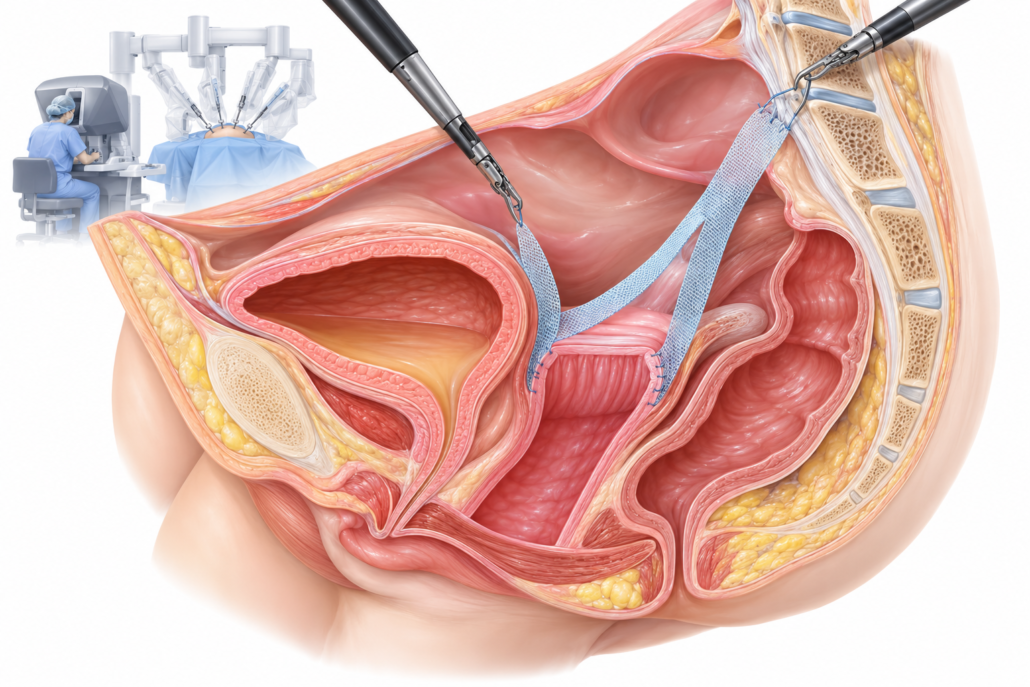
| Sacrocolpopexy (laparoscopic, robotic or open) | Mesh attached to the vagina is fixed to the ligament over the sacrum through the abdomen. | Often durable apical support; abdominal operative risks and mesh-specific risks must be weighed. |
| Colpocleisis | The vaginal canal is closed or substantially shortened. | Effective option for selected women who do not wish to retain vaginal intercourse; the loss of vaginal intercourse is permanent. |
An anterior repair may be added if the front wall remains significantly prolapsed after apical support is restored. These operations can also be combined with treatment of stress incontinence when the benefits and added risks justify it. The decision is individual. [1–3]
Where does robotic sacrocolpopexy fit?
Robotic sacrocolpopexy is one way to perform abdominal sacrocolpopexy through small incisions. The robot helps the surgeon control instruments; it does not perform the surgery independently. It may be considered for symptomatic, substantial or recurrent vault prolapse, especially when preserving vaginal length and durable apical support are priorities, or when multiple compartments need reconstruction. It is not necessary for every prolapse and is not suitable for every patient. Previous abdominal operations, anaesthetic risk, ability to tolerate the operating position, mesh preferences, surgeon experience and costs all matter. [1–4]
Compared with vaginal operations using the patient’s own tissue, sacrocolpopexy generally has lower rates of recurrent prolapse and repeat prolapse surgery in studies of post-hysterectomy vault prolapse. In the 2023 Cochrane review, illustrative estimates were 6 in 100 requiring repeat surgery after sacrocolpopexy versus 14 in 100 after vaginal procedures, and 8 in 100 noticing recurrent prolapse versus 18 in 100 after vaginal procedures. These are pooled comparisons, not predictions for an individual. The certainty and length of follow-up vary. [3]
A multicentre randomised trial reported a 36-month composite treatment-failure estimate of 28% with sacrocolpopexy and 43% with vaginal native-tissue repair. Its definition combined symptoms, examination findings and retreatment: it does not mean 28% underwent another operation. Women in all groups reported sustained improvement, with similar satisfaction and decision regret. [4]
The benefit shown for sacrocolpopexy should not be attributed specifically to the robot. Comparative studies have not established better long-term anatomical or patient-reported results for robotic versus conventional laparoscopic sacrocolpopexy. Operating time and cost can be higher with robotic surgery, depending on the centre and surgeon. The quality of the repair and the experience of the team may matter more than the instrument platform. [5,6]
Risks and complications
Every prolapse operation can involve bleeding, infection, clots, anaesthetic complications, injury to the bladder, bowel or ureters, temporary difficulty emptying the bladder, new or persistent urinary leakage or urgency, constipation, pain with intercourse, and recurrence. A bulge can return in a different compartment even when the apex remains well supported. Some women need further treatment. Individual risk varies with previous operations and health. [1–4]
Sacrocolpopexy adds risks associated with abdominal access and permanent mesh, including mesh exposure through the vagina, infection, pain, and rarely erosion into an organ or complications near the sacrum. Mesh complications can arise years later and sometimes require further surgery. The 2024 randomised trial reported mesh exposure in about 3% after sacrocolpopexy during its follow-up; this is a study figure, not a lifetime risk. Vaginal native-tissue surgery avoids implanted mesh but has its own risks, including buttock pain with sacrospinous fixation and ureteric obstruction or injury with uterosacral suspension. [1,3,4]
An Australian distinction: Mesh inserted through the vagina to repair prolapse is not available for routine supply in Australia. That is different from mesh inserted through the abdomen for sacrocolpopexy, which remains an available category of device. An operation should never be described simply as “mesh-free” or “mesh surgery” without explaining the route, material and specific risks. [7]
Making a decision
There is no single best operation for every woman. A useful consultation covers how bothersome the bulge is; whether a pessary has been tried; the degree of vault and anterior prolapse; bladder, bowel and sexual symptoms; previous repairs; the wish to avoid mesh; the wish to maintain vaginal intercourse; likely recovery; and the surgeon’s experience with each approach. It should distinguish improvement in symptoms from an examination-based definition of anatomical success. For women seeking a durable reconstruction, sacrocolpopexy is an important option; vaginal native-tissue surgery remains a valid choice, particularly when avoiding abdominal surgery or mesh matters more. [1–4]
This article provides general information and cannot replace an individual examination and discussion of personal risks and goals.
References
- NICE. Urinary incontinence and pelvic organ prolapse in women: management (NG123). 2019, subsequent updates.
- RCOG. Pelvic organ prolapse: patient information.
- Maher C, et al. Surgery for women with apical vaginal prolapse. Cochrane Database Syst Rev. 2023;7:CD012376. doi:10.1002/14651858.CD012376.pub2.
- Menefee SA, et al. Apical suspension repair for vaginal vault prolapse: a randomized clinical trial. JAMA Surg. 2024.
- Robotic compared with laparoscopic sacrocolpopexy: a randomized controlled trial. Obstet Gynecol. 2014.
- Ferrari A, et al. Laparoscopic versus robot-assisted sacrocolpopexy: systematic review and meta-analysis. 2026.
- Therapeutic Goods Administration. About transvaginal surgical mesh devices.


Leave a Reply
Want to join the discussion?Feel free to contribute!