
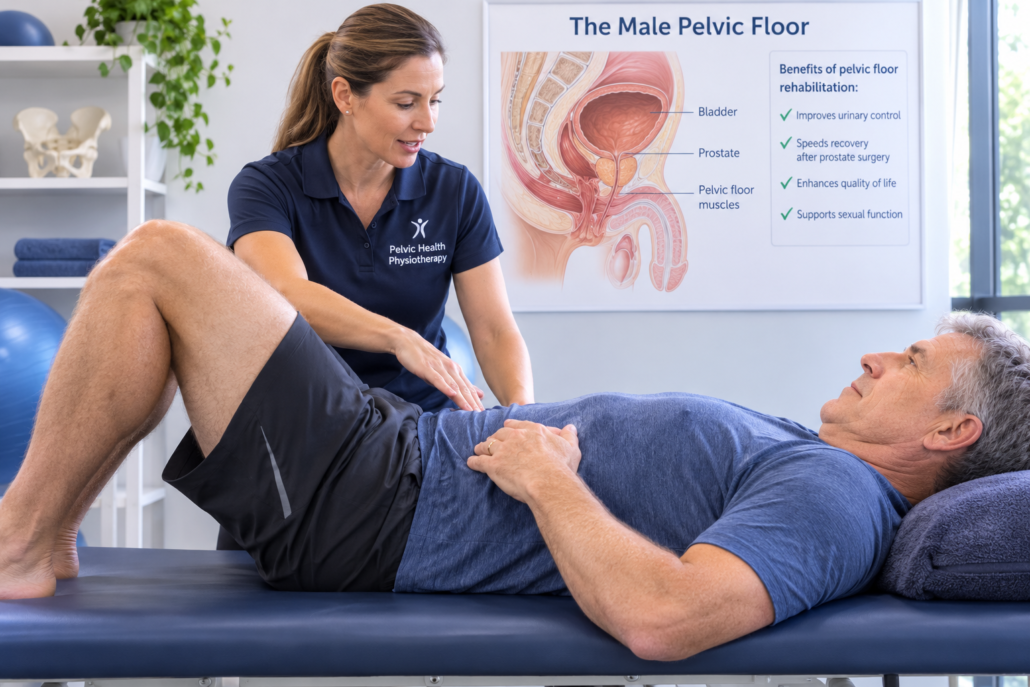
Pelvic Floor Rehabilitation Before and After Prostate Surgery
Preparing the Pelvic Floor for Recovery
Urinary leakage is one of the most common concerns men have when preparing for prostate surgery, particularly radical prostatectomy for prostate cancer. Fortunately, urinary control usually improves progressively after surgery, and pelvic floor rehabilitation can play an important role in helping men regain continence.
Pelvic floor rehabilitation is more than simply “doing Kegels”. It involves learning which muscles to use, how to contract them correctly, when to relax them, and how to incorporate them into everyday activities.
Importantly, more exercise is not necessarily better. The aim is a pelvic floor that is strong, coordinated and responsive, rather than one that is constantly clenched.
What Is the Male Pelvic Floor?
The pelvic floor is a group of muscles forming a supportive sling beneath the pelvis. These muscles contribute to:
- urinary continence;
- bowel control;
- support of the pelvic organs;
- sexual function; and
- control of pressure generated during coughing, lifting and physical activity.
After radical prostatectomy, the anatomy of the urinary continence mechanism changes. The prostate and prostatic urethra are removed and the bladder is reconnected to the remaining urethra. Urinary control consequently becomes more dependent upon the remaining urinary sphincter and its supporting pelvic floor musculature.
This is why pelvic floor rehabilitation is particularly relevant after prostate cancer surgery.
Why Start Pelvic Floor Rehabilitation Before Surgery?
Ideally, pelvic floor rehabilitation begins before the operation.
The principal advantage of pre-operative training is not necessarily building dramatically stronger muscles. Rather, it gives the patient an opportunity to identify and correctly activate the pelvic floor before surgery, when there is no catheter, discomfort or postoperative urinary leakage.
Evidence regarding whether pre-operative pelvic floor muscle training independently improves long-term continence rates is mixed. Current European guidelines conclude that pre-operative training has not consistently demonstrated an additional long-term benefit. However, pelvic floor muscle training after radical prostatectomy may shorten the time taken to recover continence.
For many patients, a consultation with a physiotherapist experienced in men’s pelvic health before surgery is therefore useful.
Finding the Correct Pelvic Floor Muscles
A pelvic floor contraction should feel as though you are trying to:
stop yourself passing wind while simultaneously shortening or drawing the penis slightly inward and lifting the scrotum.
The movement should be subtle.
During the contraction:
- continue breathing normally;
- avoid holding your breath;
- keep the abdomen relatively relaxed;
- avoid strongly squeezing the buttocks;
- avoid excessive tightening of the thighs; and
- completely relax the pelvic floor between contractions.
Some men find the correct muscles immediately. Others inadvertently brace their abdominal, buttock or thigh muscles.
This is one reason why an assessment by a pelvic floor physiotherapist can be valuable.
Should I stop my urine flow to find the muscles?
Stopping the urinary stream once can sometimes help identify the muscles involved, but repeatedly practising pelvic floor exercises by interrupting urination is generally not recommended.
Regularly stopping and starting the stream can interfere with normal bladder emptying.
A Practical Pelvic Floor Exercise Programme
There is no single exercise prescription that is perfect for every man. Pelvic floor strength, endurance, coordination and postoperative continence vary considerably.
A physiotherapist may therefore modify the programme according to your examination and progress.
A typical programme contains several components.
1. Slow contractions: strength and endurance
Gently contract and lift the pelvic floor.
Hold the contraction for approximately:
5–10 seconds
Then relax completely for approximately:
5–10 seconds
Repeat approximately:
8–10 times
The quality of the contraction is more important than achieving a particular number.
If you can only maintain a good contraction for three seconds initially, three good seconds are preferable to ten seconds of straining.
2. Quick contractions
The urinary sphincter also needs to react rapidly.
Contract the pelvic floor firmly for approximately one second, then completely release it.
Repeat:
5–10 times
These faster contractions help train the pelvic floor to respond to sudden increases in abdominal pressure.
3. The “Knack”
One of the most useful techniques is learning to contract the pelvic floor immediately before an activity that normally produces leakage.
For example, gently activate the pelvic floor just before:
- coughing;
- sneezing;
- standing from a chair;
- bending;
- lifting;
- getting out of a car; or
- performing physical exercise.
This anticipatory contraction is sometimes called the Knack.
It turns pelvic floor training from an isolated exercise into a functional skill.
How Often Should I Exercise?
This is where the principle of quality rather than quantity becomes important.
For many men, a structured programme performed two to three times per day is sufficient during active rehabilitation.
A session might consist of:
8–10 controlled slow contractions followed by 5–10 quick contractions.
However, this should not be regarded as a universal prescription. Your physiotherapist or surgeon may recommend a different programme according to your muscle strength, continence and ability to relax the pelvic floor.
The pelvic floor is skeletal muscle. Like other muscles, it needs work, recovery and progression.
Doing hundreds of contractions every day is rarely necessary.
Can You Do Too Many Pelvic Floor Exercises?
Yes.
One of the common misconceptions after prostate surgery is:
“If ten exercises are good, one hundred must be better.”
Unfortunately, pelvic floor muscles can become fatigued just like any other muscle.
Excessive training or constantly holding the pelvic floor contracted can potentially cause:
- pelvic or perineal discomfort;
- difficulty relaxing the pelvic floor;
- urinary urgency;
- difficulty starting urination;
- interrupted urinary flow;
- a sensation of incomplete bladder emptying;
- pelvic muscle fatigue; and
- occasionally worsening leakage later in the day as the muscles tire.
A healthy pelvic floor needs to be able to contract strongly and relax completely.
Continence does not require walking around all day with the pelvic floor permanently switched on.
How Do I Know When I Am Doing Enough?
Your programme is probably adequate when you can:
- identify the pelvic floor reliably;
- contract it without excessive abdominal or buttock activity;
- maintain several controlled contractions without losing strength;
- completely relax between contractions;
- activate the muscles quickly before coughing or lifting; and
- progressively incorporate pelvic floor control into normal activities.
Progress after prostatectomy is often better measured by continence rather than the number of exercises performed.
Useful measures include:
- number of pads used each day;
- degree of pad wetness;
- a 24-hour pad-weight test;
- leakage during walking or exercise;
- ability to remain dry overnight;
- ability to reach the toilet without leakage; and
- changes over several weeks rather than from one day to the next.
When Should Exercises Restart After Surgery?
Follow the instructions given by your surgeon.
Pelvic floor contractions are usually stopped while the urinary catheter is in place.
Training can generally recommence after catheter removal once your surgical team considers it appropriate. European guidance notes that pelvic floor muscle training is commonly started approximately 7–10 days after catheter removal, although individual postoperative protocols vary.
Early exercises should be gentle.
This is not the time to test how hard you can squeeze.
As healing progresses, the programme can gradually move from basic contractions to functional training while standing, walking, coughing, lifting and exercising.
What Should I Expect After the Catheter Comes Out?
The first few days can be confronting.
Some men have relatively little leakage immediately. Others experience considerable leakage, particularly when:
- standing;
- walking;
- coughing;
- exercising;
- getting out of a chair; or
- becoming tired later in the day.
This does not necessarily predict the final outcome.
Continence often improves substantially during the first weeks and months following radical prostatectomy.
Recovery is a marathon measured in millilitres rather than kilometres.
How Successful Is Pelvic Floor Physiotherapy?
This question is more complicated than it initially appears.
Urinary continence frequently improves naturally following prostatectomy, making it difficult for studies to separate the effect of pelvic floor physiotherapy from normal postoperative recovery.
The research is consequently mixed.
The European Association of Urology notes that systematic reviews and trials suggest pelvic floor muscle training can shorten the time to continence recovery, although the evidence regarding supervised training, biofeedback and additional therapies remains inconsistent.
For example, one randomised study cited by the EAU compared supervised physiotherapist-directed pelvic floor training with verbal and written instructions. At 12 months, complete pad-free continence was reported in 65.2% of the supervised group versus 31.6% of the comparison group. This result should not be interpreted as the expected success rate for every patient, because continence definitions, surgical techniques and rehabilitation programmes differ considerably between studies.
A 2023 Cochrane review was considerably more cautious. After reviewing 25 trials, the authors concluded that uncertainty remains regarding the magnitude of benefit from conservative treatments because studies vary considerably in their techniques, combinations of treatments and methodological quality.
The practical message is therefore:
Pelvic floor rehabilitation is an important first-line treatment and may accelerate recovery, but it cannot guarantee continence.
What If Pelvic Floor Exercises Are Not Working?
Persistent leakage does not automatically mean you need to exercise harder.
If continence is failing to improve, the first question should be:
Why am I leaking?
Post-prostatectomy urinary incontinence may result from:
- weakness of the urinary sphincter;
- bladder overactivity;
- urinary urgency;
- incomplete bladder emptying;
- bladder-neck or urethral narrowing;
- a combination of stress and urgency incontinence; or
- less commonly, other urinary tract problems.
The AUA guideline emphasises distinguishing stress incontinence, where leakage occurs with coughing, walking, lifting or exertion, from urgency incontinence, where leakage accompanies a sudden compelling desire to urinate.
No amount of extra squeezing will correct every one of these problems.
When Should Further Investigation Be Considered?
Further assessment may be appropriate when urinary leakage is:
- severe;
- worsening rather than improving;
- associated with difficulty urinating;
- associated with significant urgency or frequency;
- persistent despite appropriate rehabilitation; or
- sufficiently troublesome that surgical treatment is being considered.
Assessment may include:
Bladder diary
Records fluid intake, urinary frequency, urinary volumes and leakage episodes.
Pad-weight testing
Provides an objective measurement of the amount of urine being lost.
Urinary flow measurement and bladder ultrasound
Can identify poor urinary flow or incomplete bladder emptying.
Cystoscopy
May be recommended when urethral or bladder-neck pathology is suspected.
Urodynamic studies
Can sometimes help distinguish sphincter weakness from bladder dysfunction when the cause of persistent leakage is uncertain or before further treatment.
What Alternatives Are Available if Physiotherapy Is Not Enough?
Pelvic floor rehabilitation is only one part of managing post-prostatectomy incontinence.
Lifestyle and bladder strategies
These may include:
- appropriate fluid intake;
- reducing excessive caffeine;
- avoiding constipation;
- weight management where appropriate;
- bladder training;
- management of urinary urgency; and
- modifying activities that provoke significant leakage during early recovery.
Continence pads
Modern male continence pads provide discreet protection while continence is recovering.
Using pads does not mean rehabilitation has failed. They are simply a tool for allowing normal activity during recovery.
Penile compression devices
A penile clamp can temporarily reduce leakage in selected men, although these devices must be fitted and used correctly and released regularly to avoid excessive pressure or tissue injury.
Medication
Medication does not generally correct true post-prostatectomy sphincter weakness.
However, medication may be useful when overactive bladder or urinary urgency contributes significantly to leakage.
Biofeedback
Biofeedback can help some patients understand whether they are contracting the correct muscles and how effectively they are doing so.
Electrical stimulation
Electrical stimulation has also been investigated. Some studies suggest an early benefit when combined with pelvic floor training, although evidence remains inconsistent.
When Is Surgery Considered?
A small proportion of men continue to experience significant stress urinary incontinence despite adequate healing and rehabilitation.
If the leakage remains bothersome, further treatment should be discussed rather than simply continuing increasingly intensive pelvic floor exercises indefinitely.
The two principal surgical options are:
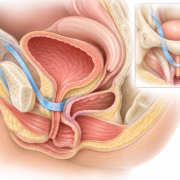
Male Sling
A male sling supports and repositions the urethral continence mechanism.
It is generally most suitable for selected men with mild to moderate stress urinary incontinence and adequate residual sphincter function.
Results tend to be less favourable when incontinence is severe. The AUA guideline specifically notes that male sling outcomes are poorer in men with severe sphincteric incontinence.
Artificial Urinary Sphincter
The artificial urinary sphincter (AUS) remains an important treatment for moderate to severe post-prostatectomy stress urinary incontinence.
A fluid-filled cuff is placed around the urethra and controlled by a small pump positioned within the scrotum. The patient operates the pump when he wishes to urinate.
Both male sling surgery and artificial urinary sphincter implantation can significantly reduce pad use and improve quality of life in appropriately selected men.
When Should I Stop Pelvic Floor Rehabilitation?
There is rarely a precise finishing date.
Once continence has returned and pelvic floor control is good, intensive rehabilitation can usually be reduced.
Many men transition from a rehabilitation programme to a simple maintenance programme, incorporating occasional pelvic floor exercises and functional contractions during activities that generate abdominal pressure.
If you are completely dry, have good pelvic floor control and can cough, lift and exercise without leakage, performing increasingly large numbers of exercises is unlikely to provide additional benefit.
The goal is not to become a professional Kegel athlete.
The goal is normal function.
The Bottom Line
Pelvic floor rehabilitation is an important component of recovery following radical prostatectomy.
Learning the technique before surgery can make it easier to identify and activate the correct muscles after the catheter is removed. Following surgery, a structured programme focusing on strength, endurance, rapid contractions, relaxation and functional activation may help accelerate the return of urinary control. Current evidence supports pelvic floor muscle training as part of postoperative management, while acknowledging that the precise additional benefit of intensive supervised physiotherapy remains uncertain.
Just as importantly, more is not always better. Persistent leakage should not automatically be treated with ever-increasing numbers of pelvic floor contractions.
If urinary incontinence remains troublesome despite appropriate rehabilitation, further assessment can determine whether the problem is persistent sphincter weakness, bladder dysfunction or another cause. Treatments ranging from bladder therapy and medication to a male sling or artificial urinary sphincter can then be considered.
A useful rule
Train the pelvic floor, don’t exhaust it.
Correct technique, consistency and functional control matter far more than the number of contractions performed.
This information is intended for general patient education and does not replace individual medical advice. The timing and intensity of pelvic floor rehabilitation should be discussed with your surgeon and/or a physiotherapist experienced in male pelvic health.



Leave a Reply
Want to join the discussion?Feel free to contribute!