
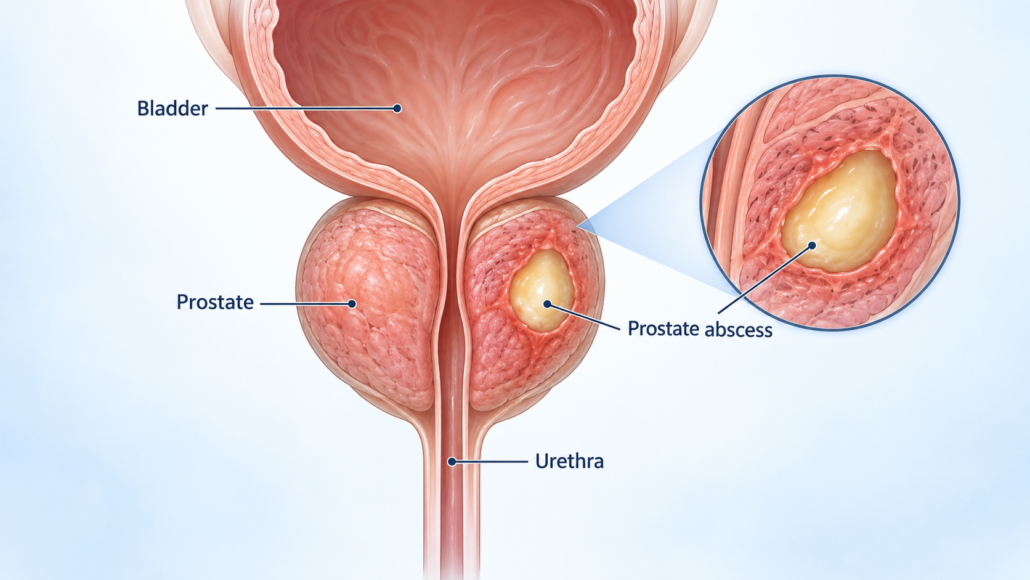
Prostate Abscess: A Rare but Serious Infection
A prostate abscess is a collection of pus within the prostate gland. It usually develops as a complication of acute bacterial prostatitis when infection progresses despite treatment or when treatment has been delayed.
Prostate abscesses are uncommon, but they can become life-threatening if the infection spreads into the bloodstream. Early diagnosis, intravenous antibiotics and, when necessary, drainage of the abscess are essential.
What causes a prostate abscess?
Most prostate abscesses develop when bacteria enter the prostate from the urinary tract. The infection may begin in the bladder or urethra and travel backwards through the prostatic ducts.
Common bacteria include:
- Escherichia coli
- Klebsiella species
- Pseudomonas species
- Proteus species
- Enterococcus species
- Staphylococcus aureus, including resistant strains such as MRSA
Less commonly, bacteria reach the prostate through the bloodstream from an infection elsewhere in the body. Fungal and tuberculosis-related abscesses are rare but may occur in people with significant immune suppression.
Who is at increased risk?
A prostate abscess is more likely to develop in men with:
- Diabetes, particularly when blood glucose is poorly controlled
- A weakened immune system
- Long-term corticosteroid or immunosuppressive treatment
- HIV or another significant immune disorder
- Difficulty emptying the bladder
- Benign prostate enlargement
- A urethral stricture
- A long-term urinary catheter
- Recent urinary tract instrumentation
- Recent prostate biopsy or prostate surgery
- Recurrent urinary tract infections
- Chronic kidney disease or dialysis
- Intravenous drug use
- Acute bacterial prostatitis that is not improving with appropriate antibiotics
Diabetes is one of the most frequently identified risk factors. High blood glucose can impair the immune response and make infection more difficult to control.
How does a prostate abscess present?
The symptoms often resemble acute prostatitis or a severe urinary tract infection. A man may experience:
- Fever, chills or shaking
- Pain or burning when passing urine
- Frequent or urgent urination
- Difficulty starting or maintaining the urinary stream
- Inability to pass urine
- Pain in the pelvis, perineum, groin or lower back
- Painful ejaculation
- Blood in the urine
- Cloudy or unpleasant-smelling urine
- General weakness, nausea or confusion
On examination, the prostate may be enlarged, tender or feel unusually soft or fluctuant. However, the absence of a typical prostate examination does not exclude an abscess.
Forceful prostate massage should be avoided in someone with acute prostatitis or a suspected abscess because it may push bacteria into the bloodstream.
When should a prostate abscess be suspected?
A prostate abscess should be considered when a patient with acute prostatitis:
- Remains febrile after approximately 48–72 hours of appropriate antibiotics
- Becomes more unwell despite treatment
- Develops urinary retention
- Has persistent pelvic or perineal pain
- Has recurrent infection with the same organism
- Has diabetes, immune suppression or another major risk factor
Symptoms alone cannot reliably distinguish an abscess from uncomplicated prostatitis. Imaging is usually needed to confirm the diagnosis.
How is it diagnosed?
Initial investigations may include:
- Urine microscopy and culture
- Blood cultures, preferably before antibiotics when this does not delay treatment
- Full blood count
- Kidney function and electrolyte tests
- Inflammatory markers
- Blood glucose testing
- Blood lactate and other sepsis investigations when the patient is seriously unwell
Imaging may be performed using:
Transrectal ultrasound
Transrectal ultrasound can demonstrate one or more fluid-filled cavities within the prostate. It can also be used to guide needle drainage.
CT scan
A CT scan of the pelvis is particularly useful when the patient is very unwell or when infection may have spread beyond the prostate. It can also identify urinary obstruction, stones or another source of infection.
MRI
MRI provides detailed images of the prostate and surrounding tissues. It may be helpful when ultrasound or CT findings are unclear, but it is not always the most practical first investigation in an emergency.
Is a prostate abscess an emergency?
A prostate abscess can lead to bloodstream infection, sepsis and septic shock. Patients with fever, shaking chills, confusion, low blood pressure, rapid breathing, severe weakness or inability to pass urine require urgent hospital assessment.
Emergency management may involve:
- Immediate assessment for sepsis
- Blood and urine cultures
- Intravenous fluids
- Prompt intravenous antibiotics
- Pain relief
- Monitoring of blood pressure, urine output and kidney function
- Treatment of uncontrolled diabetes
- Urgent urinary drainage if the bladder cannot empty
- Early consultation with a urologist and, when appropriate, an infectious diseases physician
Antibiotics should not be delayed in a patient who is septic while waiting for scans or culture results.
If urinary retention is present, bladder drainage is required. A urethral catheter may sometimes be used carefully, but a suprapubic catheter inserted through the lower abdomen may be preferred when urethral catheterisation is difficult or likely to cause significant prostate irritation. The best approach depends on the patient’s condition and anatomy.
Treatment with antibiotics
All prostate abscesses require antibiotic treatment.
A patient who is systemically unwell will usually begin treatment with broad-spectrum intravenous antibiotics. The initial antibiotic choice depends on:
- The likely source of infection
- Local bacterial resistance patterns
- Previous urine culture results
- Recent hospital admission or antibiotic exposure
- Recent catheterisation or urinary surgery
- Kidney function
- Drug allergies
- The possibility of resistant bacteria or Staphylococcus aureus
Once culture results become available, treatment can be narrowed to an antibiotic that targets the identified organism and penetrates prostate tissue effectively.
After clear clinical improvement, intravenous treatment may be changed to an appropriate oral antibiotic. Treatment is usually longer than for a simple bladder infection and commonly continues for several weeks. The exact duration depends on the organism, abscess size, success of drainage, immune status and response to treatment.
Follow-up urine cultures and repeat imaging may be required to confirm that the infection and abscess have resolved.
Can antibiotics alone cure a prostate abscess?
Occasionally, a small abscess in a clinically stable patient can be treated with antibiotics and close observation. This is more likely to succeed when the collection is small, often less than approximately 1 cm, and drains naturally into the prostatic ducts.
There is no single size threshold that applies to every patient. Larger, multiloculated or persistent abscesses are less likely to resolve with antibiotics alone.
Drainage should be considered when:
- The patient is septic or clinically deteriorating
- Fever persists despite appropriate antibiotics
- The abscess is relatively large
- There are several abscess cavities
- The abscess is not shrinking on repeat imaging
- Urinary obstruction is present
- The infecting organism is difficult to eradicate
- The patient has diabetes or significant immune suppression
- The infection repeatedly returns
Current European guidance recognises that both conservative treatment and drainage may be appropriate in selected patients, with abscess size and clinical response helping to guide the decision. EAU Guidelines on Urological Infections
How is a prostate abscess drained?
Several drainage techniques are available. The method chosen depends on the size and position of the abscess, whether it has multiple compartments, the patient’s condition and local expertise.
Transrectal ultrasound-guided aspiration
A needle is passed through the rectum into the abscess under ultrasound guidance, and the pus is aspirated.
Advantages include:
- Minimally invasive treatment
- Usually limited anaesthesia
- Collection of pus for culture
However, the abscess may refill, particularly if it is large, thick-walled or divided into several compartments. Repeat aspiration may be needed.
Transperineal drainage
A needle or drain is inserted through the skin between the scrotum and anus under ultrasound or imaging guidance.
This approach avoids passing through the rectal wall and may allow a drainage catheter to remain temporarily. It can be useful for appropriately positioned abscesses or when repeated drainage is anticipated.
Transurethral drainage
A telescope is passed through the urethra, and the abscess cavity is opened internally so that it can drain into the urinary channel. This may be performed by incision, deroofing or limited resection of the involved prostate tissue.
Transurethral drainage is often considered when:
- The abscess is large
- There are multiple or deep cavities
- Needle aspiration has failed
- The abscess has recurred
- Prostate enlargement is contributing to obstruction
- Rapid and complete drainage is required
Possible complications include bleeding, urinary infection, temporary worsening of urinary symptoms, retrograde ejaculation, urethral stricture and, less commonly, urinary incontinence or injury to surrounding structures.
Open or laparoscopic surgery
Open, laparoscopic or robotic drainage is rarely required. It may be considered if the abscess extends outside the prostate, cannot be reached by less invasive methods or is associated with another condition requiring surgery.
Antibiotics plus effective drainage remain the central principles of treatment. Management of prostate abscess in the absence of guidelines and MSD Manual: Prostate Abscess
What happens after drainage?
The drained fluid is sent for microbiological testing. This is important because the organism within the abscess may differ from that found in the urine.
Following drainage, the patient usually continues antibiotics. Clinical improvement is monitored by checking:
- Temperature and general wellbeing
- Pain and urinary symptoms
- White blood cell count and inflammatory markers
- Kidney function
- Blood glucose in patients with diabetes
- Urine and blood culture results
- Follow-up ultrasound, CT or MRI when indicated
Any contributing problem, such as bladder obstruction, a urethral stricture, a catheter or poorly controlled diabetes, should also be addressed to reduce the risk of recurrence.
What is the outlook?
With early recognition, appropriate antibiotics and adequate drainage, most prostate abscesses can be successfully treated.
Delayed treatment may result in:
- Sepsis or septic shock
- Spread of infection beyond the prostate
- Fistula formation into nearby structures
- Recurrent urinary infection
- Chronic pelvic discomfort
- Prolonged difficulty passing urine
- Rarely, death from overwhelming infection
A prostate abscess should therefore be regarded as a potentially serious complication of prostatitis rather than an ordinary urinary infection.
When should you seek urgent medical attention?
Attend an emergency department urgently if you develop:
- Fever or shaking chills with urinary symptoms
- Confusion, faintness or severe weakness
- Inability to pass urine
- Severe pelvic or perineal pain
- Rapid breathing or a racing heartbeat
- Persistent fever despite antibiotics
- Worsening symptoms after treatment for prostatitis
Early assessment is particularly important for men with diabetes, immune suppression, a urinary catheter or recent urinary tract surgery.
This information is intended for general education and does not replace individual medical assessment. A suspected prostate abscess requires urgent assessment by a medical practitioner and usually early involvement of a urologist.


Leave a Reply
Want to join the discussion?Feel free to contribute!