

Movember: PSA testing: what it can tell you, and what it can’t
An informed conversation with your GP can help you decide whether a PSA test is right for you. Your age, family history, general health and preferences all matter.
Movember is a good time to talk about men’s health, including prostate cancer. One of the most useful steps is often a simple conversation with your GP about prostate-specific antigen (PSA) testing. A PSA blood test can help identify men who may need further assessment, but it is not a yes-or-no cancer test. Understanding what it can and cannot show helps you make an informed choice.
What is PSA?
PSA is a protein made by cells in the prostate. A small amount normally enters the bloodstream, where it can be measured with a blood test. PSA is prostate-specific, but not cancer-specific: a higher result can occur with prostate cancer, but also with benign prostate enlargement, inflammation or infection, urinary retention, or after some urinary procedures. PSA levels also tend to rise with age.
A PSA test is different from a digital rectal examination (DRE). The blood test measures PSA. A DRE is an examination in which a clinician feels the prostate through the rectum. A DRE is not routinely required as an addition to PSA testing for an asymptomatic man under RACGP guidance, although examination may be useful when symptoms or other findings make it appropriate.
Why do we use PSA?
Prostate cancer may cause no symptoms in its early stages. PSA testing can identify a result that deserves a closer look before symptoms develop. Used thoughtfully, early detection may help find clinically significant cancer while treatment or monitoring options remain available.
There are limits and possible harms. PSA can be raised when cancer is not present, leading to anxiety, repeat tests, scans and sometimes biopsy. It can also find a slow-growing cancer that would never have caused a problem during a person’s lifetime. Diagnosis and treatment can have side effects, including changes to urinary continence and sexual function. The chance of benefit depends on a person’s risk, health and life expectancy. That is why Australian guidance recommends an informed discussion before testing rather than testing everyone automatically.
Is PSA a good marker for prostate disease or prostate cancer?
PSA is a useful risk marker, not a diagnosis. It can help estimate the chance of prostate cancer and guide whether further assessment is sensible. It is not a reliable general test for every prostate problem, and it cannot by itself distinguish cancer from benign enlargement or inflammation.
A low PSA lowers the chance of prostate cancer but does not make it zero. A raised PSA does not mean that cancer is present. If the result is higher than expected for a person’s age and risk, the GP will usually consider the whole picture and repeat the test before acting on a single result. Infection, inflammation, retention and recent instrumentation can affect the result, so timing and clinical context matter.
If PSA remains elevated, further assessment may include a clinical review, examination when appropriate, and prostate MRI. Current Australian guidance recommends multiparametric MRI before biopsy. A biopsy, when indicated, is what confirms whether cancer is present and provides information about its grade. Not everyone with a raised PSA needs a biopsy.
How often should PSA be tested?
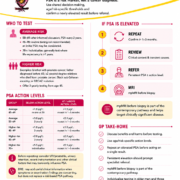
Australia’s guidance has evolved. The RACGP’s Guidelines for preventive activities in general practice (Red Book, 10th edition, 2024) recommends offering informed men at average risk aged 50–69 PSA testing every two years if they choose regular testing. It recommends testing every two years from age 45 for men at moderately increased risk because of family history, and from age 40 for those at high risk due to family history, through age 69.
USANZ’s published PSA position statement is described as an interim document pending updates to the PCFA and RACGP guidelines. It supports an individualised, risk-based discussion for well-informed men over 50 with an adequate life expectancy, earlier testing from over 45 for men with a family history or higher-risk ethnicity, and from over 40 for men with a BRCA2 mutation.
Since those documents, the NHMRC approved the 2026 Guidelines for the Early Detection of Prostate Cancer in Australia. These are the latest national recommendations and give the following general pathway for people who decide to test after discussion with their GP:
| Age and risk | General testing approach |
|---|---|
| Average risk, age 50–69 | Offer PSA testing every two years. |
| Higher risk, age 45 and over | Offer testing every two years, using lower PSA levels to trigger a repeat test and possible referral. |
| Age 70 and over | Individualise the decision. The guideline generally considers testing when estimated life expectancy is more than seven years. |
| Age 45–49, not at higher risk | Routine testing is not recommended; an initial test may be discussed if the person is interested. |
The 2026 guideline defines higher risk to include having a brother with prostate cancer; a father diagnosed before age 65; two or more second-degree relatives who died from prostate cancer; Black sub-Saharan ancestry; or a confirmed BRCA2 mutation. Family-history details and other health factors still need to be discussed with a GP. The guideline uses age- and risk-specific PSA action levels; a result at or above an action level is generally repeated within one to three months, rather than treated as a cancer diagnosis.
These recommendations guide discussion; they are not a substitute for individual advice. Screening recommendations apply to people without symptoms. If you have symptoms, your GP may recommend assessment regardless of your age or the usual testing interval.
How important is family history?
Family history can make a real difference. Prostate cancer in a close relative, especially a brother, or a father diagnosed at a younger age, can increase a person’s risk and may mean discussing PSA testing earlier than age 50. Multiple affected relatives can also point to an inherited risk. A known BRCA2 mutation is another important risk factor.
If you know that prostate cancer has affected your family, tell your GP which relative was affected and how old they were when diagnosed. Also mention any known breast, ovarian, pancreatic or other cancers in the family, as these may help the GP decide whether genetic counselling or testing should be discussed. Do not wait for symptoms before raising a strong family history.
When should I see a urologist?
Your GP is usually the right first contact. A referral to a urologist may be appropriate if a repeat PSA remains at or above the age- and risk-based action level, if the prostate examination is concerning, or if MRI or other findings suggest that specialist assessment is needed. A urologist can discuss the benefits and limits of further tests, including MRI and biopsy, and help decide on next steps.
Make an appointment with your GP if you notice persistent or new urinary problems, blood in your urine or semen, or ongoing unexplained pain. These symptoms can have many causes and do not automatically mean prostate cancer, but they deserve assessment. Do not wait for a routine PSA check if you have a concerning symptom. If you cannot pass urine, seek urgent medical care.
A useful Movember conversation
Ask your GP: “Given my age, health and family history, should I have a PSA test? If we test, how often should I repeat it, and what would we do if it is raised?” Knowing your family history and discussing the possible benefits and harms can make the decision more useful than simply ordering a blood test without a plan.
Movember is a reminder to look out for one another. Start the conversation, share what you know about your family history, and encourage the men in your life to seek advice when something does not feel right.
This article provides general information and is not a substitute for personal medical advice. PSA testing is a shared decision between you and your healthcare professional.
References and further information
- Prostate Cancer Foundation of Australia. 2026 Guidelines for the Early Detection of Prostate Cancer in Australia: summary and recommendations. NHMRC approved 18 May 2026.
- The Royal Australian College of General Practitioners. Guidelines for preventive activities in general practice, 10th edition — prostate cancer, recommendations updated 28 June 2024.
- Urological Society of Australia and New Zealand. PSA Testing position statement. Interim guidance pending updated guidelines.
- Huang S, Chen DC, Crowe J, et al. Navigating the shift: New RACGP Red Book guidelines for prostate-specific antigen testing in general practice. Australian Journal of General Practice. 2025;54(12). Article PDF.






Leave a Reply
Want to join the discussion?Feel free to contribute!