
Balanitis Xerotica Obliterans and Lichen Sclerosus of the Foreskin
Balanitis xerotica obliterans—usually abbreviated to BXO—is the traditional urological name for male genital lichen sclerosus.
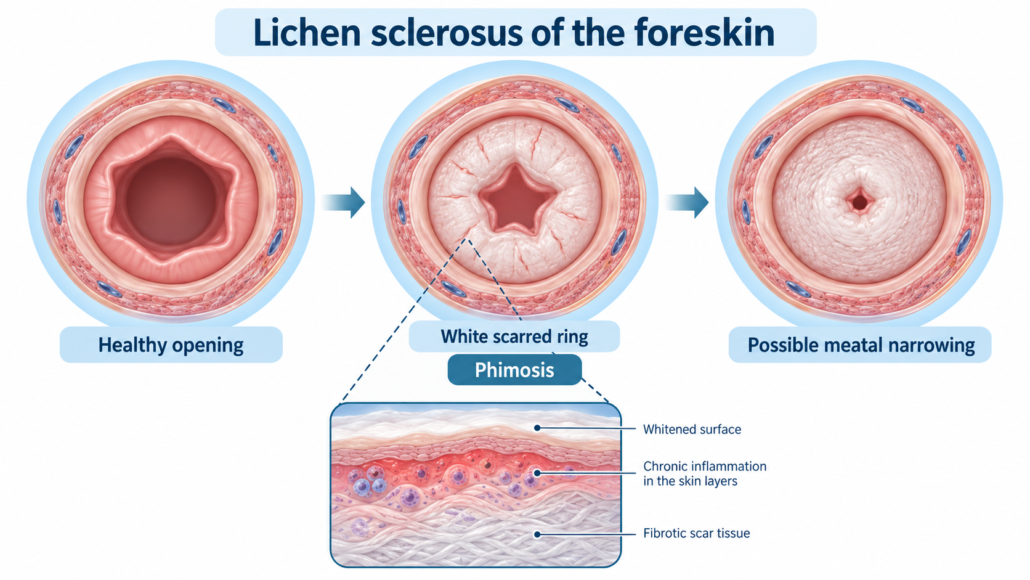
Lichen sclerosus is a chronic inflammatory skin condition that most commonly affects the foreskin and head of the penis. It can cause whitening, inflammation, splitting and progressive scarring of the foreskin. In some men it also narrows the urinary opening or extends into the urethra.
BXO is not simply an infection or ordinary balanitis. Early recognition and treatment can relieve symptoms and reduce permanent scarring. Long-term observation is also important because genital lichen sclerosus is associated with a small but genuine risk of penile squamous cell carcinoma.
Is BXO different from lichen sclerosus?
The names are often used interchangeably:
- Lichen sclerosus is the preferred modern medical term.
- Balanitis xerotica obliterans describes lichen sclerosus affecting the glans penis and foreskin, particularly when scarring has developed.
The condition may involve:
- The inner and outer foreskin
- The glans penis
- The frenulum
- The urinary opening—the meatus
- The fossa navicularis and penile urethra
The disease is usually confined to the genital region in men, although lichen sclerosus can occasionally affect skin elsewhere.
What causes lichen sclerosus?
The exact cause remains uncertain. It is probably produced by a combination of inflammation, immune-system dysfunction, genetic susceptibility, skin injury and local environmental factors.
Possible associations include:
- Autoimmune or inflammatory activity
- Chronic exposure of susceptible skin to trapped urine
- Repeated friction or minor trauma
- A tight foreskin
- Previous inflammation beneath the foreskin
- Obesity and a “buried” penis
- Diabetes or metabolic disease
- Cigarette smoking
- Genetic susceptibility
The moist, occluded environment beneath the foreskin may contribute to continuing inflammation in susceptible men.
Lichen sclerosus is:
- Not caused by poor personal character or behaviour
- Not usually a sexually transmitted infection
- Not contagious
- Not something that can be passed to a partner through ordinary sexual contact
Yeast or bacterial infection may occur at the same time, particularly in men with diabetes, but infection is not the underlying cause of lichen sclerosus.
Who can develop it?
Male genital lichen sclerosus can occur at any age.
It is recognised in:
- Boys with acquired or severe scarring phimosis
- Adolescents
- Younger and middle-aged men
- Older men
- Men with a previously retractable foreskin that has gradually tightened
It is much less common in men who were circumcised early in life, although circumcision does not make the risk absolutely zero.
How does lichen sclerosus present?
The appearance varies considerably. Early disease can be subtle and may initially be mistaken for thrush, dermatitis, recurrent balanitis or ordinary phimosis.
Possible signs include:
- White, pale or porcelain-coloured foreskin
- A white, firm ring around the foreskin opening
- Thickened or hardened skin
- Shiny, crinkled or “cigarette-paper” skin
- Red or inflamed areas
- Small cracks or splits
- Easy bleeding or bruising
- Painful erosions
- Adhesions between the foreskin and glans
- Progressive tightening of the foreskin
- Shortening or scarring of the frenulum
- Whitening around the urinary opening
- Narrowing of the meatus
- Loss of the normal shape or definition of the glans and foreskin
Some men have significant visible disease with surprisingly little discomfort.
Symptoms patients may notice
Symptoms can include:
- Difficulty retracting the foreskin
- Inability to replace or retract the foreskin fully
- Pain during erections
- Splitting or bleeding during intercourse
- Itching, burning or soreness
- Recurrent “balanitis”
- Pain or reduced enjoyment during sexual activity
- Spraying or deflection of the urinary stream
- A weak or narrowed stream
- Straining to urinate
- Dribbling after urination
- Ballooning of the foreskin
- Recurrent urinary infections
- Difficulty emptying the bladder
A narrow urinary opening may be the first sign that the disease has extended beyond the foreskin.
Lichen sclerosus and phimosis
Phimosis means that the foreskin cannot be retracted comfortably behind the glans.
A non-retractile foreskin is normal in young boys and does not automatically indicate disease. However, a previously retractable foreskin that becomes tight—particularly when accompanied by a white scarred ring—is suspicious for lichen sclerosus.
Forceful stretching of a scarred foreskin is not recommended. Repeated tearing may cause additional inflammation and scarring.
Paraphimosis, where a retracted tight foreskin becomes trapped behind the glans, requires urgent medical attention.
How is lichen sclerosus diagnosed?
The diagnosis is often made from the history and characteristic appearance.
Assessment should include examination of:
- The complete foreskin
- Glans penis
- Frenulum
- Urinary opening
- Palpable tissue beneath abnormal skin
- Urinary stream and bladder emptying when relevant
- Groin lymph nodes if cancer is suspected
Other conditions that can resemble lichen sclerosus include:
- Fungal or bacterial balanitis
- Irritant or allergic dermatitis
- Psoriasis
- Lichen planus
- Zoon balanitis
- Vitiligo
- Genital warts
- Penile intraepithelial neoplasia—PeIN
- Squamous cell carcinoma
Diabetes testing may be appropriate in men with recurrent inflammation or other risk factors.
Is a biopsy always necessary?
Not every typical case requires a biopsy before treatment. However, biopsy is important when:
- The diagnosis is uncertain
- Treatment has not produced the expected response
- An erosion or ulcer does not heal
- There is a persistent red or thickened area
- A lump or hardened area can be felt
- The skin bleeds easily without an obvious cause
- Pigmentation changes unexpectedly
- Penile intraepithelial neoplasia or cancer is suspected
When circumcision is performed for suspected lichen sclerosus, the foreskin should usually be sent for pathological examination.
A biopsy should be taken from any suspicious persistent lesion rather than relying only on the appearance.
Medical management
The goals of medical treatment are to:
- Suppress inflammation
- Relieve discomfort and itching
- Prevent further scarring
- Preserve foreskin and urinary function where possible
- Identify patients who require surgery or biopsy
General skin care
Helpful measures include:
- Washing gently with water or a non-soap cleanser
- Avoiding perfumed soaps, antiseptics and harsh products
- Drying the glans and foreskin gently after urination
- Applying a bland barrier ointment or emollient
- Avoiding forceful foreskin retraction
- Using adequate lubrication during sexual activity
- Stopping smoking
- Managing diabetes carefully
- Addressing obesity or a buried penis where relevant
Good hygiene means gentle care. Repeated scrubbing or strong antiseptics can worsen inflamed genital skin.
Potent topical corticosteroids
A prescribed potent or ultrapotent topical corticosteroid is the usual first-line medical treatment.
Clobetasol propionate 0.05% ointment is commonly used in specialist practice. A typical initial course may involve a small amount applied to the affected skin once daily for one to three months, but the exact regimen should be determined by the treating doctor.
Patients should be shown:
- Exactly where to apply the medication
- How much to use
- How long to continue
- Whether treatment should be reduced gradually
- When follow-up is required
When used correctly for a defined course, topical corticosteroids can reduce inflammation, soreness and early tightening. They cannot always reverse established dense scar tissue.
Possible steroid-related effects include irritation, secondary infection, skin thinning or visible small blood vessels, although these are uncommon with appropriate genital use and medical supervision.
Other topical treatments
Topical calcineurin inhibitors such as tacrolimus or pimecrolimus may occasionally be considered by a dermatologist or experienced specialist when corticosteroids are unsuitable.
They are not generally preferred over potent topical corticosteroids as initial treatment. They can cause burning or irritation, and persistent suspicious lesions must be biopsied rather than repeatedly treated empirically.
Antifungal or antibiotic medication is only useful when a secondary infection is actually present. It does not treat the underlying lichen sclerosus.
When should circumcision be considered?
Circumcision is an important and often definitive treatment for foreskin lichen sclerosus.
It should be considered when there is:
- Established scarring phimosis
- Painful or recurrent splitting
- Difficulty with hygiene
- Recurrent balanitis
- Paraphimosis
- Failure to respond adequately to a prescribed steroid course
- Rapid recurrence after apparently successful medical treatment
- Significant functional or sexual difficulty
- Concern about premalignant or malignant change
- A need to obtain tissue for diagnosis
Complete circumcision removes the diseased foreskin and eliminates the moist, urine-exposed environment beneath it. Many men experience long-term resolution when the disease is limited to the foreskin.
Partial circumcision or simply making a slit in the scarred foreskin is generally less reliable because affected skin remains and may scar again.
Will circumcision cure lichen sclerosus?
Circumcision is often highly effective when the condition is limited to the foreskin. However, it is not an absolute guarantee of cure.
Disease may persist or recur on the:
- Glans
- Coronal sulcus
- Frenulum
- Urinary opening
- Urethra
Ongoing symptoms or abnormal skin after circumcision should therefore be reviewed rather than assumed to be normal postoperative scarring.
Circumcision appears to reduce the risk associated with chronic inflammation and phimosis, but it does not completely eliminate the future risk of penile cancer.
Surgery for meatal narrowing
Lichen sclerosus can scar the urinary opening, producing meatal stenosis.
Symptoms may include:
- A thin urinary stream
- Spraying or deflection
- Prolonged urination
- Straining
- Discomfort
- Incomplete emptying
Treatment may require a meatotomy or meatoplasty, in which the opening is enlarged and reconstructed.
Simple dilatation may provide temporary improvement but often does not control active scar disease. Medical treatment of the surrounding lichen sclerosus and continued surveillance may still be required.
What if the disease involves the urethra?
In some men, scarring extends from the meatus into the penile urethra and occasionally further towards the bulbar urethra.
Assessment may include:
- Urinary flow-rate testing
- Post-void residual ultrasound
- Flexible cystoscopy
- Retrograde urethrogram
- Voiding cystourethrogram
- Urethral ultrasound in selected cases
Short strictures may sometimes be managed endoscopically, but repeated dilatation or urethrotomy has a significant recurrence risk when active lichen sclerosus remains.
Longer or recurrent strictures may require urethroplasty. Oral lining tissue—usually buccal mucosa from the inside of the cheek—is commonly used for reconstruction.
The European Association of Urology recommends that genital skin should not be used as a graft for lichen-sclerosus-related urethral strictures, because the disease can affect the graft and recurrence rates are poor.
Complex cases are best managed by a urologist experienced in reconstructive urethral surgery.
Other surgical options
Depending on the extent of disease, specialist procedures may include:
- Frenuloplasty in carefully selected cases without extensive LS
- Complete circumcision
- Meatotomy or meatoplasty
- Excision or biopsy of suspicious lesions
- Glans resurfacing when premalignant disease is present
- Oral-mucosa graft urethroplasty
- Staged urethral reconstruction
- Perineal urethrostomy for severe or recurrent extensive stricture disease
The operation should be tailored to the location and activity of the condition. Preserving diseased genital skin simply to avoid circumcision may produce repeated scarring and further procedures.
Lichen sclerosus and penile cancer
Male genital lichen sclerosus is associated with squamous cell carcinoma of the penis and with penile intraepithelial neoplasia, which is a precancerous change.
Published studies have reported widely differing cancer rates among men with genital lichen sclerosus—from close to zero in some groups to approximately 12.5% in highly selected specialist series. Frequently quoted estimates place the risk at roughly 2–6%, but the precise lifetime risk for an individual man remains uncertain.
This does not mean that most men with lichen sclerosus will develop penile cancer. Penile cancer remains rare, and appropriate treatment of inflammation and phimosis is expected to reduce risk.
It is also reported that lichen sclerosus is found in a substantial proportion of penile cancer specimens. This association cannot be reversed to mean that the same proportion of men with lichen sclerosus will develop cancer.
Risk is likely to be greater when there is:
- Long-standing uncontrolled inflammation
- Severe phimosis
- Persistent ulceration or thickening
- Poor visibility of the glans
- Cigarette smoking
- Immune suppression
- Coexisting penile intraepithelial neoplasia
- Failure to attend follow-up
Warning signs that require prompt review
A man with current or previous lichen sclerosus should seek medical assessment for:
- A persistent ulcer or sore
- A new lump or firm area
- Skin thickening
- An irregular red or velvety patch
- A warty or cauliflower-like growth
- Unexplained bleeding
- Offensive discharge
- Increasing pain
- A lesion that does not respond to prescribed steroid treatment
- A new lump in the groin
These findings do not necessarily mean cancer, but they should not be treated repeatedly as thrush or simple inflammation without further investigation.
Follow-up and self-examination
Lichen sclerosus can recur, and cancer-related changes may develop many years after initial treatment.
Patients should become familiar with the normal appearance of their penis and perform regular self-examination. When possible, the entire glans, foreskin and urinary opening should be inspected.
Medical follow-up should be tailored to disease severity. More frequent review is appropriate during active treatment, after surgery or when urethral involvement is present. Once stable, periodic or annual review may be appropriate, together with lifelong self-monitoring.
Circumcised men should still report new or persistent abnormalities.
The outlook
When recognised early, male genital lichen sclerosus can often be controlled successfully with appropriate topical corticosteroid treatment, good skin care and follow-up.
Established scarring is less likely to resolve with medication alone. Circumcision is usually highly effective for disease confined to the foreskin, while meatal and urethral disease may require more specialised reconstruction.
The important message is not to ignore a foreskin that is becoming progressively white, scarred or tight. Early assessment may prevent painful erections, urinary obstruction and more complex surgery.
The bottom line
Balanitis xerotica obliterans is the older name for male genital lichen sclerosus involving the foreskin and glans.
It commonly presents with white or scarred skin, acquired phimosis, splitting, painful erections or urinary-stream changes. Potent prescribed topical corticosteroids are the first medical treatment for suitable early disease, while circumcision is often required for established phimosis, recurrent disease or failure of medical treatment.
Meatal or urethral involvement requires urological assessment and may need reconstructive surgery.
The risk of penile squamous cell carcinoma is small but real. Persistent thickening, ulceration, bleeding, a lump or a lesion that does not respond to treatment requires prompt examination and often biopsy.
This article provides general information and does not replace personalised medical assessment. Do not use potent topical corticosteroids on genital skin without appropriate medical advice.
So guys, if you cannot retract the foreskin and has the typical appearance discussed in this article, take the time to review with your GP to have this checked out. There is effective management for this which will also then reduce your risk for penile cancer. Do not vary your head in the send and ignore this, have it seen to and let your GP refer you to your local Brisbane urologist, Dr Jo Schoeman.
References and further reading
- British Association of Dermatologists—Lichen sclerosus in males
- British Association of Dermatologists—Guidelines for the management of lichen sclerosus
- European Association of Urology—Penile Cancer Guidelines
- European Association of Urology—Urethral Stricture Guidelines
- DermNet—Lichen sclerosus in men


Leave a Reply
Want to join the discussion?Feel free to contribute!